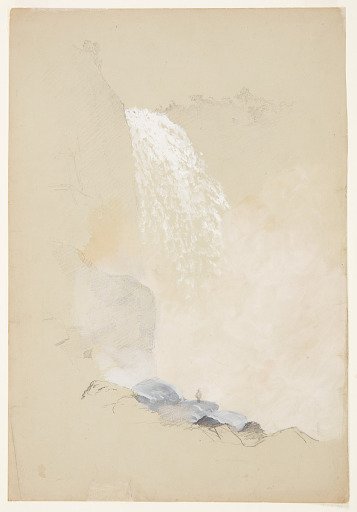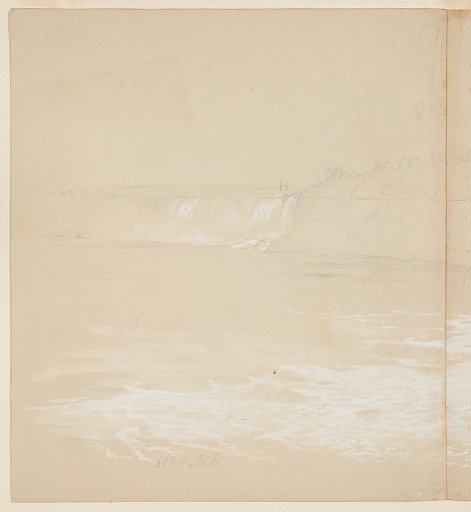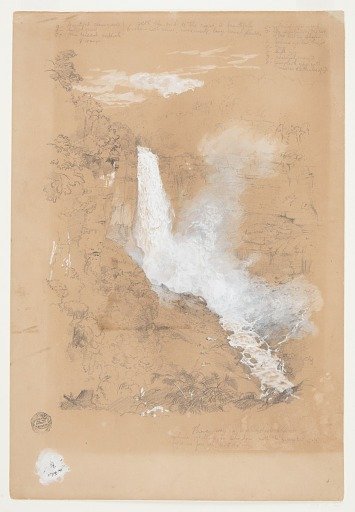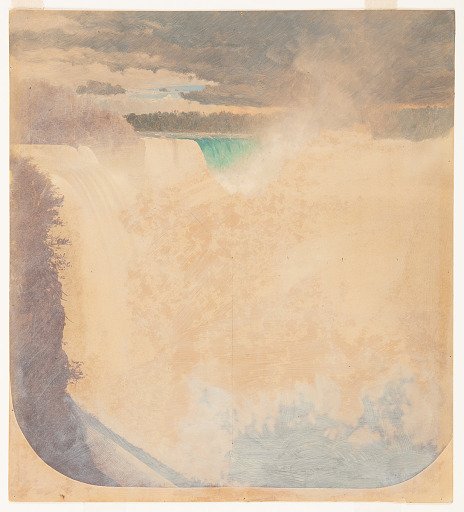
Niagara from the American Side, New York
From the collection of Cooper Hewitt, Smithsonian Design Museum. Free to download, adapt and use — no permission needed.
Landscape photograph/sketch showing a view of Niagara Falls from the American side, in New York. In this work, the artist sketched in graphite and oil paint onto a photograph known as an albumen silver print. The view includes a treetop at lower right and a cliffside with vegetation in the foreground at left. Beyond it, the American Falls lead to Goat Island, which then leads to the curving Horseshoe Falls, which extends horizontally across the composition in the middle distance. In the background, dark gray and white clouds hang above the heavily wooded bank of the Niagara River. The artist has whited out the treetop at lower right, painted the rich blue-green hue of the river's water onto the falls at center, and articulated the distant sky and riverbank in oil. At center right, an immense plume of mist kicked up by the falls is visible. Graphite guiding or perspectival lines intersect at center.
Cooper Hewitt, Smithsonian Design Museum’s own description