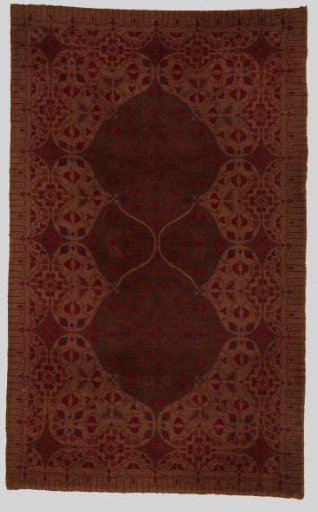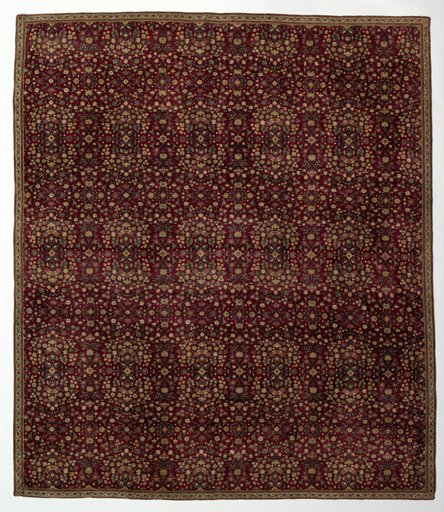
Woolen carpet with millefleurs decoration
From the collection of Cleveland Museum of Art. Free to download, adapt and use — no permission needed.
Pashmina, a very fine fiber made from the fleece of Himalayan goats, was a material highly valued at the Mughal courts. Luxury rugs functioned in several ways, including as insulators for palatial and ceremonial spaces and as framing devices for important figures. In a biography of the Mughal emperor Akbar (reigned 1556–1605), called the Ain-i-Akbari , the court historian Abu’l Fazl (1551–1602) poetically wrote that such textiles created “a beautiful flowerbed.” The description is apt, as this carpet features an impressively symmetrical floral design known as millefleurs , or “thousand flowers” in French. Viewing several of these carpets and other hangings at once would have been visually impressive for court attendees.
Cleveland Museum of Art’s own description