CC0 · no rights reserved
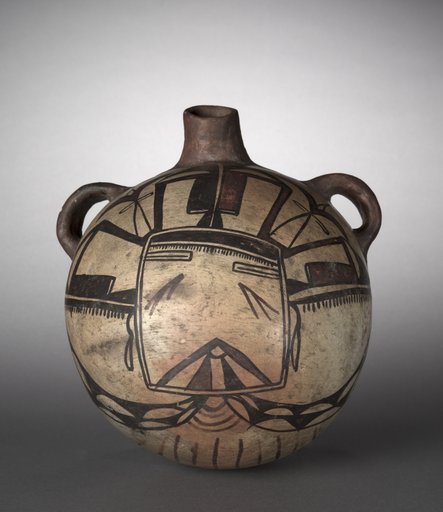
Canteen with a Katsina-like Face
From the collection of Cleveland Museum of Art. Free to download, adapt and use — no permission needed.
About this work
Since the 1500s, Hopi women made big-bellied canteens, based on Spanish prototypes, and used them to carry water. By the late 1800s, canteens became popular with Euro-American tourists, who increasingly flocked to the Southwest in search of encounters with “exotic” Native American cultures. Thus, Hopi artists embellished their wares to improve their appeal. This example is painted with a face similar to a Katsina’s, a spirit being central to Pueblo religion—but it is a fanciful rendition, not an actual Katsina. Could the maker have been taking control of her culture and its consumption by outsiders?
Cleveland Museum of Art’s own descriptionCredit lineCanteen with a Katsina-like Face, 1890. Native North America, Southwest, Arizona, Pueblo, Hopi. Ceramic, slip; overall: 21.5 x 24.5 cm (8 7/16 x 9 5/8 in.). The Cleveland Museum of Art, Gift of Amelia Elizabeth White, 1937.708
Similar works
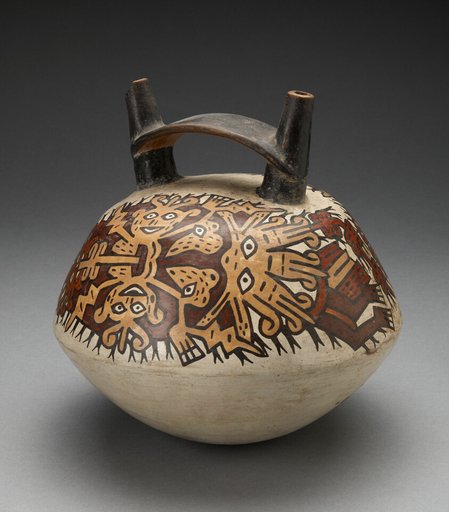 Double Spout Vessel Depicting Costumed Figure with Intricate Abstract Mask
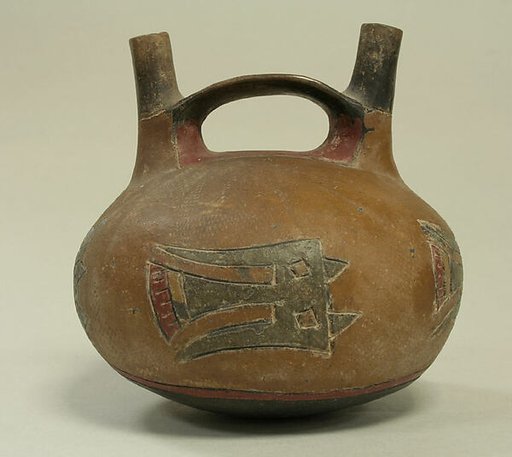 Double spout and bridge bottle with birds
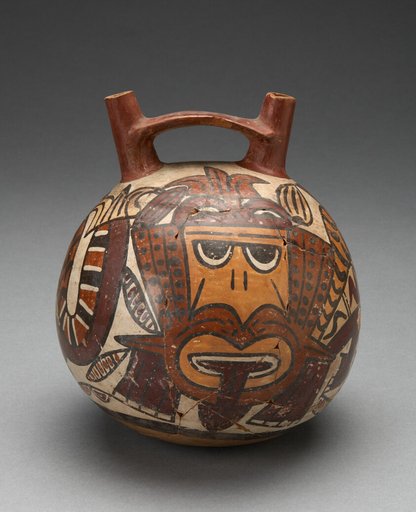 Double Spout Vessel Depicting Figure Costumed as Pampas Cat with Bean Motifs
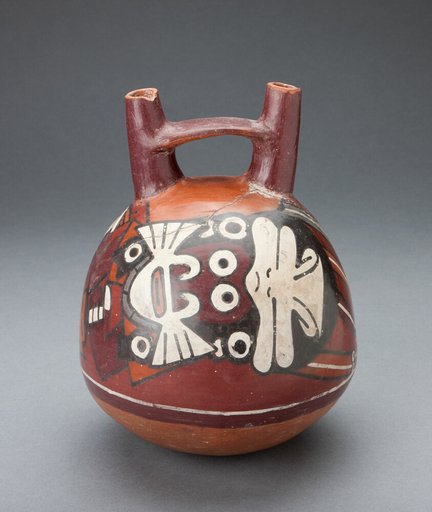 Vessel Depicting a Costumed Ritual Performer Wearing a Feline Mask
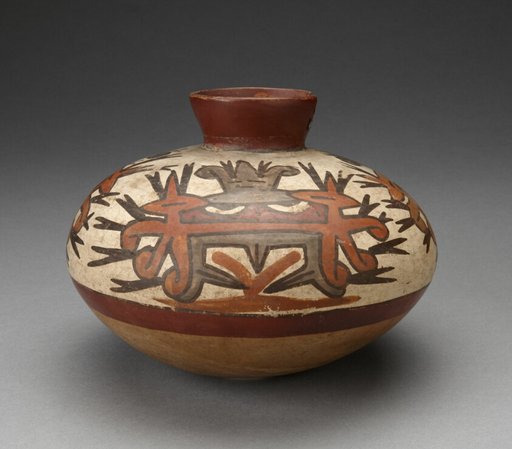 Jar with Small Neck Depicting Abstract Face of Masked Figure
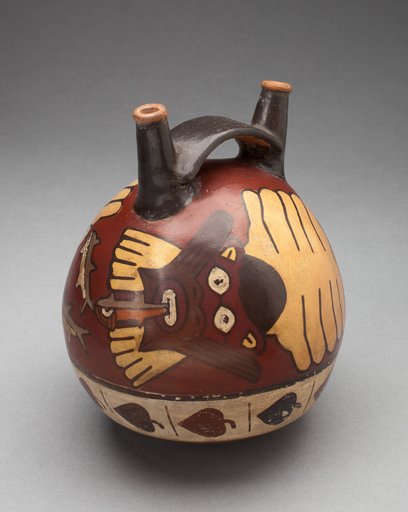 Double Spout Vessel Depicting a Costumed Ritual Performer with Sharks