CC0 · no rights reserved
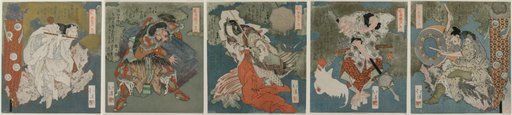
The Cave Door of Spring
From the collection of Cleveland Museum of Art. Free to download, adapt and use — no permission needed.
About this work
These prints form a composition inspired by a story about the deity Amaterasu. She was once so offended by her brother that she retreated into a cave, leaving the earth in darkness. Several attempts to lure her out with cocks crowing, music-making, and a goddess dancing failed, but a mirror hung from a nearby tree made Amaterasu curious, bringing her to the entrance of the cave. A stone was quickly placed at the entrance to block her way back into the cave, and light was restored to the world. The scene across the prints is unified by embossed clouds enriched with gold, silver, and copper.
Cleveland Museum of Art’s own descriptionCredit lineThe Cave Door of Spring (春磐戸), 1825. Totoya Hokkei (Japanese, 1780–1850). Pentaptych of woodblock prints; ink and color on paper; each: 18.8 x 21.4 cm (7 3/8 x 8 7/16 in.). The Cleveland Museum of Art, Bequest of James Parmelee, 1940.990
Similar works
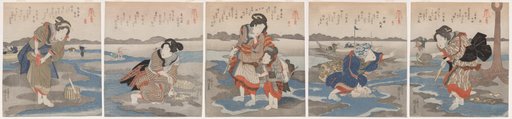 A Low Tide Pentaptych
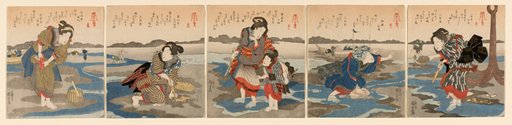 Low Tide at Susaki - A Set of Five (Shiohi goban no uchi)
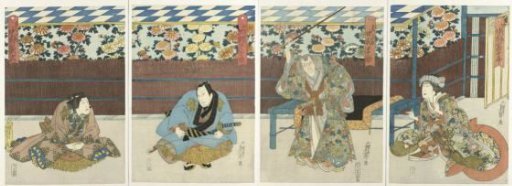 Four actors at an autumn flower exhibition
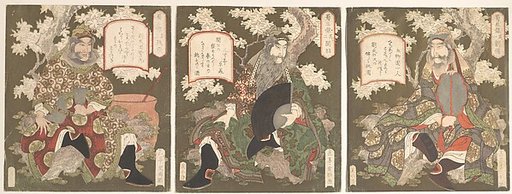 The Three Heroes of Shoku (Shu): Emperor Ryubi (Liu Fei) and His Friends Kwan-u (Kwan Yu) and Chohi (Chang Fei)
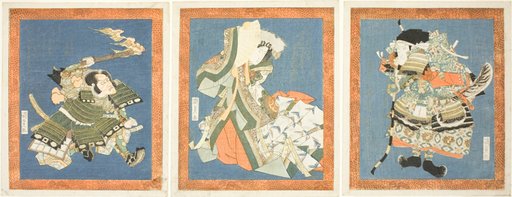 The actor Ichikawa Danjuro VII as I no Hayata
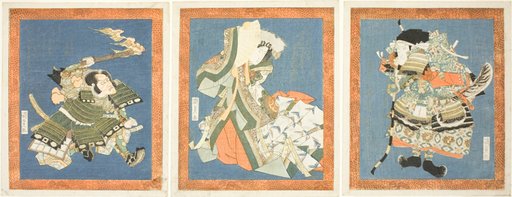 The actor Segawa Kikunojo V as Ayame no Mae