CC0 · no rights reserved
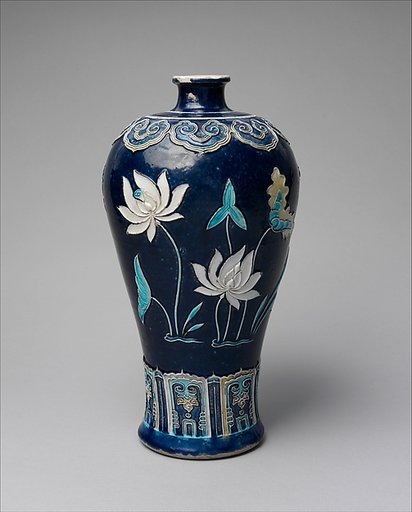
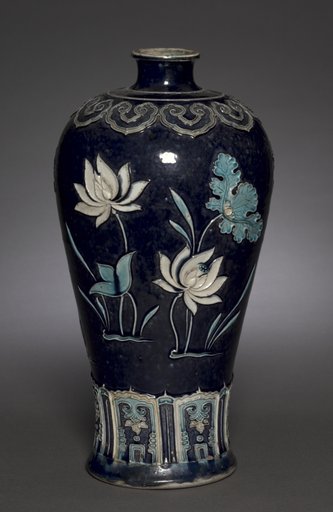
Prunus Vase (Meiping) with Blossoming Lotus
From the collection of Cleveland Museum of Art. Free to download, adapt and use — no permission needed.
About this work
According to 11th-century poet Zhou Dunyi, “all people like peonies, but I alone like the lotus because it emerges from the mud unstained.” The lotus is a symbol of purity and popular among Chinese literati and in Buddhism. This vase shows lotus flowers rising from the water’s surface depicted in elegant yet simple ripples. Made in a kiln at Jingdezhen in southern China, this vase is an example of the fahua technique—decoration with raised outlines produced by squeezing clay from a tube onto the vase’s surface. Colors are applied to fill the outlines before firing.
Cleveland Museum of Art’s own descriptionCredit linePrunus Vase (Meiping) with Blossoming Lotus (琺華蓮花紋梅瓶), late 1400s. China, Jiangxi Province, Jingdezhen kilns, Ming dynasty (1368–1644). Porcelain with polychrome glazes, Fahua ware; diameter: 19 cm (7 1/2 in.); overall: 37.5 cm (14 3/4 in.). The Cleveland Museum of Art, Bequest of John L. Severance, 1942.716