CC0 · no rights reserved
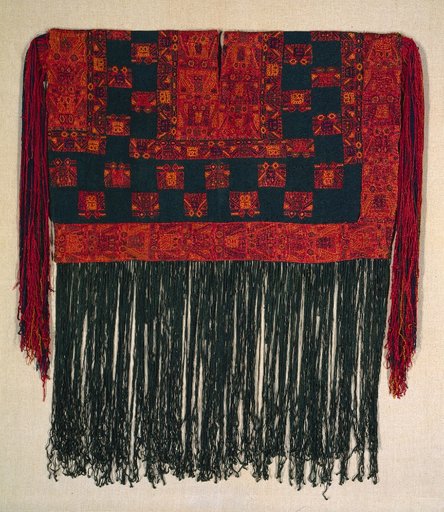
Tunic
From the collection of Cleveland Museum of Art. Free to download, adapt and use — no permission needed.
About this work
Brightly dyed wool yarns found in many ancient Peruvian textiles come mainly from alpacas that were domesticated and selectively bred to produce long, soft, lustrous fiber. The finely spun yarns in a broad range of colors as seen on this tunic—well preserved after approximately 2,000 years of burial—attest to the Paracas people’s considerable artistry. A double-headed bird motif appears multiple times throughout the tunic’s design.
Cleveland Museum of Art’s own descriptionCredit lineTunic, c. 300 BCE–200 CE. Peru, South Coast, Paracas (Cavernas) style. Alpaca wool: plain weave with embroidery and warp substitution; overall: 94 x 83.8 cm (37 x 33 in.); mounted: 111.8 x 101.6 cm (44 x 40 in.). The Cleveland Museum of Art, The Norweb Collection, 1946.227