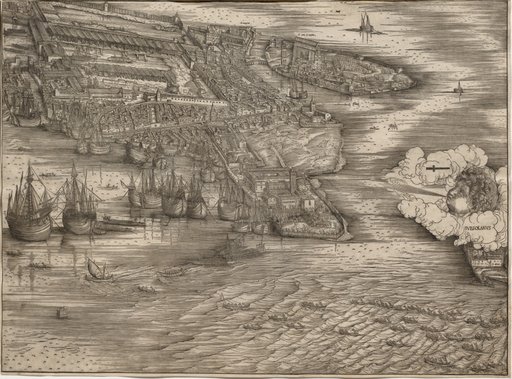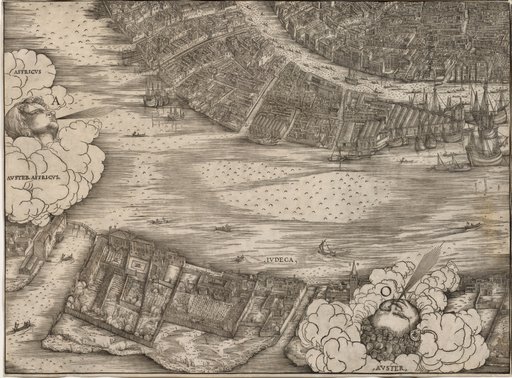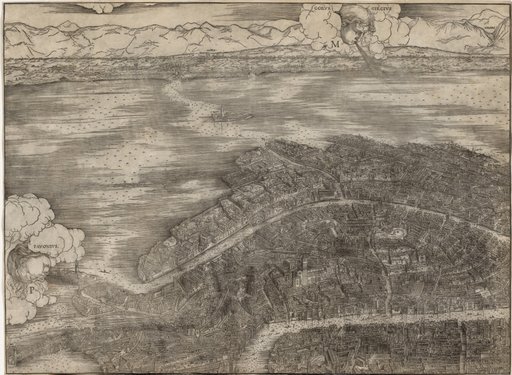
View of Venice
From the collection of Cleveland Museum of Art. Free to download, adapt and use — no permission needed.
By the end of the 15th century, Venice had emerged as the major printing center in Europe, where books were printed in various languages to be shipped around the world. The city also became the great emporium for prints, and the woodcut developed beyond its humble origins as a popular art for simple pious imagery, playing cards, and later for book illustration. View of Venice epitomizes this new ambitious scope for the woodcut. This monumental print can be compared in scale only to a mural decoration and presumably served as a less expensive surrogate for paintings. The six sheets that make up the design would have been pasted either onto a canvas or the wall itself, resulting in the survival of few fine impressions like this one. The goal of the print was to depict Venice as seen from above. No single vantage point would have been sufficient, so a large team of surveyors climbed various towers and tall buildings to record small sections of the city. These individual views were combined to form the map that follows a single, though inconsistent, system of perspective. Unprecedented for its exactness of detail and difficulty of execution, View of Venice represents the first attempt to render the image of a city according to the laws of geometry.
Cleveland Museum of Art’s own description![View of Venice [upper left block]](https://thumbs.arkivism.com/nga-37050.jpg)
![The Siege of La Rochelle [plate 5 of 16; set comprises 1952.8.97-112]](https://thumbs.arkivism.com/nga-41832.jpg)