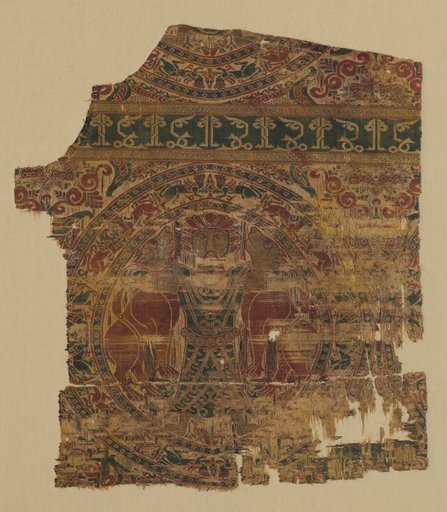
Fragment with Lion Strangler from a Dalmatic of Saint Bernard Calvo
From the collection of Cleveland Museum of Art. Free to download, adapt and use — no permission needed.
Within the elaborate roundel, a bearded man with a belted tunic strangles a lion in each hand. Gold thread shimmers on their heads and his hands. In the inscription band across the top, an Arabic word has been written with mirror-image symmetry. It can be read as al-yumn , primarily translated as prosperity . The central motif of this renowned silk is a pre- Islamic Persian symbol of royal power. Both Muslims and Christians throughout the Iberian Peninsula admired such textiles. Members of the Catholic clergy incorporated it into a dalmatic—a long ceremonial tunic. It was found in the late 1800s in the tomb of Saint Bernard Calvo, Bishop of Vich (1180–1243).
Cleveland Museum of Art’s own description