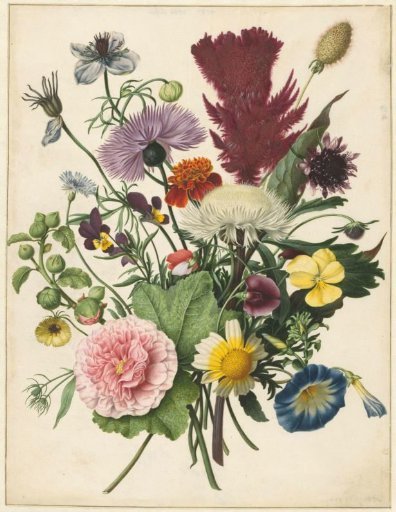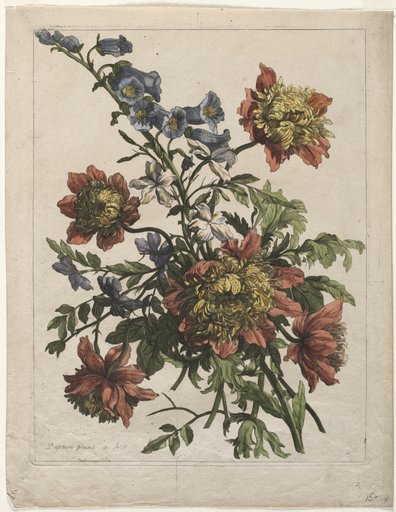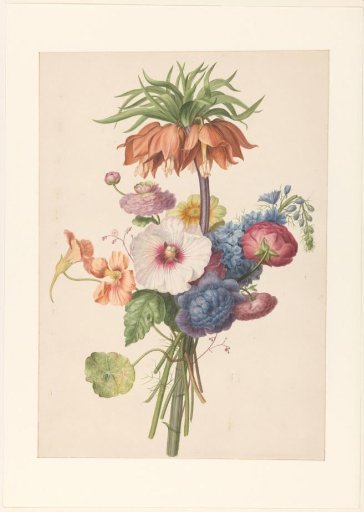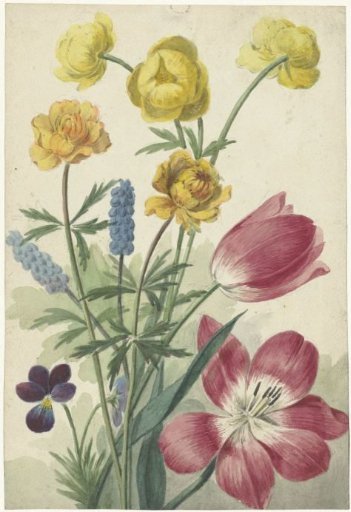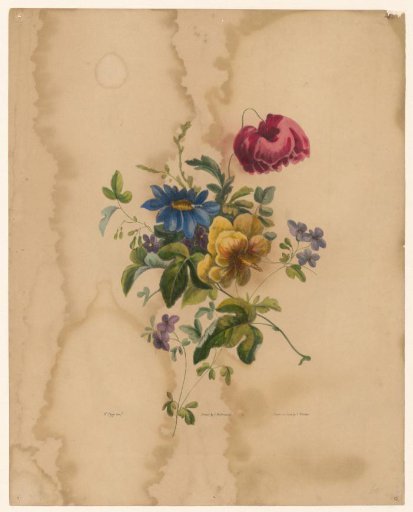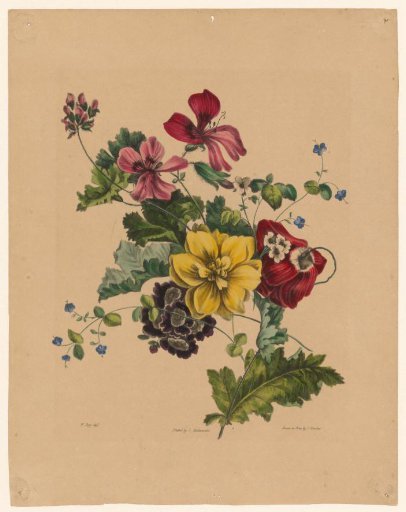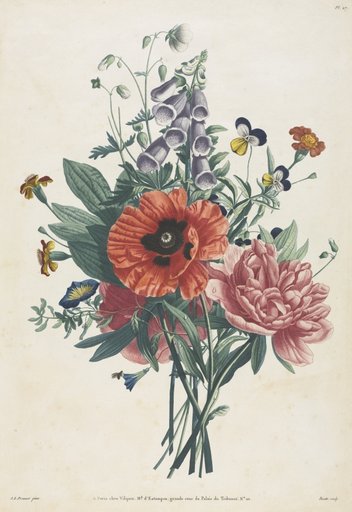
Collection of Flowers and Fruits Painted after Nature: Bouquet of Foxglove, Clematis, Pansy, Peony, Poppy, and Yellow Day Lily
From the collection of Cleveland Museum of Art. Free to download, adapt and use — no permission needed.
By the mid-17th century, there was a surge of interest in beautiful, exotic plants and formal royal gardens. At Fountainebleau and the Louvre, the gardens were filled with flowers from far-away places, such as the Near East, India, the East and West Indies, and South America. In 1735 Carl Linnaeus (1707-1778) invented the first scientific classification system for 7,700 plants. As a result, accuracy as well as artistic skill were required for the numerous portfolios of botanical prints popular with gardeners and those involved with the decorative arts. In these lavish productions, some of the color is printed but the remainder is added with watercolor, giving the illusion of transparency, luminosity, and the delicacy characteristic of flowers. Stipple was a technique developed in England from the 1760s. A point is used to build up a mass of flicks and dots to create a wide range of tones.
Cleveland Museum of Art’s own description