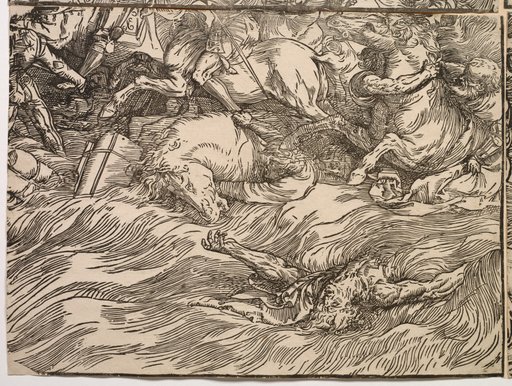
The Submersion of Pharaoh's Army in the Red Sea
From the collection of Cleveland Museum of Art. Free to download, adapt and use — no permission needed.
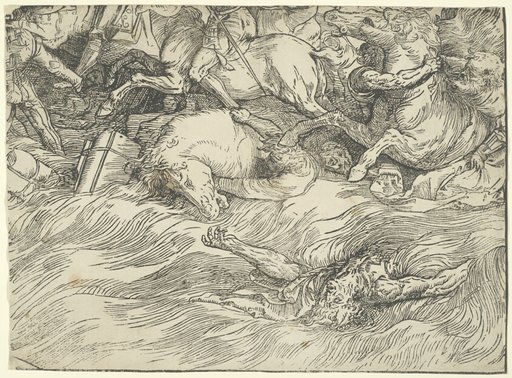
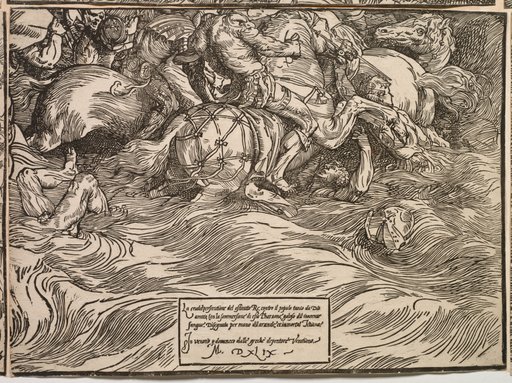
To make this monumental woodcut—considered one of the most ambitious prints of the Renaissance—Titian probably drew directly on the wooden blocks, after which a skilled cutter completed the blocks. The size rivals that of a painting, and the composition would have hung on a wall. Titian’s bold vision presents nature as a vehicle of God’s mercy and wrath. Moses, at right, having parted the seas for the Israelites to pass, commands them to close over the Egyptian forces (Exodus 14:21–31). Titian propelled the narrative with remarkable unity, dedicating entire blocks to the turbulent sea and rolling clouds that culminate in a magnificent cliff and Renaissance city. Some have interpreted the scene as an allegory of Venice’s troubles with the League of Cambrai, a military alliance that threatened the island city.
Cleveland Museum of Art’s own description