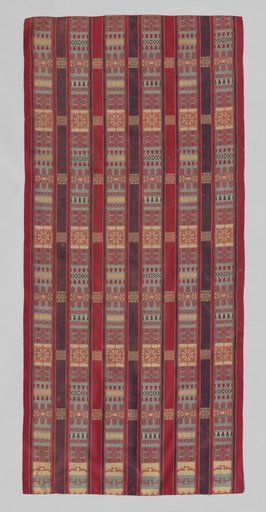
Panel from a Head Covering (‘Ajar)
From the collection of Cleveland Museum of Art. Free to download, adapt and use — no permission needed.
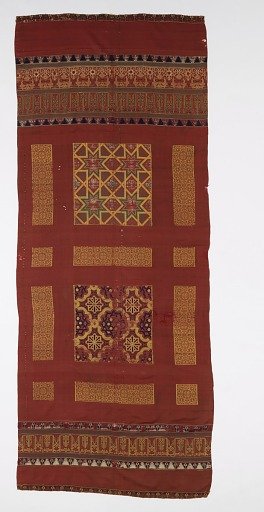
This panel was part of an urban Tunisian woman’s head-covering ( ‘ajar ). Two such panels flanked a face-obscuring black panel. Such luxurious garments of seclusion were once reserved for elites. The decorative panels draped down when worn, showing off the finely woven motifs and demonstrating the wearer’s family wealth. Arranged in bands, motifs include stylized trees (or protective hands), flowers, eight-pointed stars, and geometric designs. The mirrored Kufic (squared Arabic script) lettering in teal is likely the name of the weaver or panel owner. Weavers with Muslim Andalusian (southern Spanish) heritage originally made these, drawing from Andalusian and Turkish motifs; later, workshops in Tunis produced them.
Cleveland Museum of Art’s own description