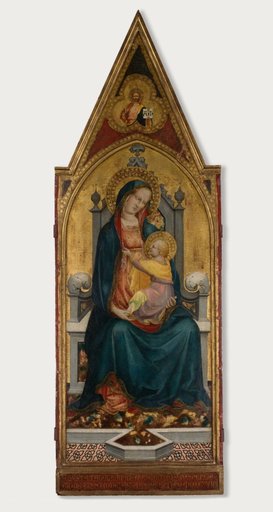
Virgin and Child Enthroned
From the collection of Cleveland Museum of Art. Free to download, adapt and use — no permission needed.
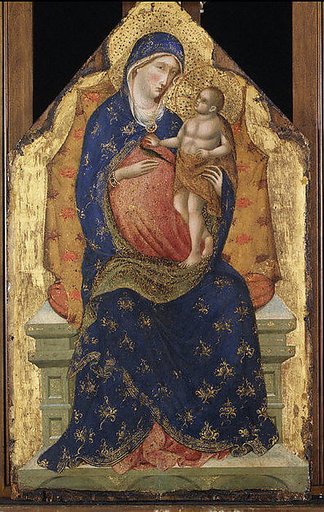
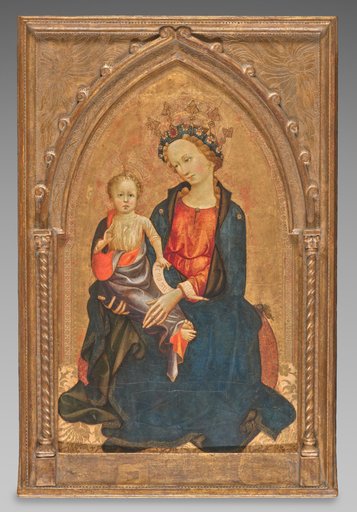
Rather than depicting a single moment in time, this gold-ground painting symbolically encapsulates Christ. Seated on a rich throne, the monumental Virgin holds the Christ child. Above, the risen Christ is seen in heaven holding a book, inscribed with the alpha and omega, the first and last letters of the Greek alphabet, signifying Christ’s role as the beginning and end of all things. The Italian inscription states: "This painting was made for Antonio di Domenicho Giugni for the repose of his soul, the year of our Lord 1419." In the 1300s, Italian painting focused on the heavenly aspects of Christian faith in order to convey abstract religious concepts. Depicted as specimens of formal beauty, sacred figures were placed against an ethereal gold background. Within a hundred years, artists began to highlight the earthly aspects of sacred figures, placing them within naturalistic landscapes. In this newer style of painting, the approachability of sacred figures fostered devotion among the faithful.
Cleveland Museum of Art’s own description
![Madonna and Child Enthroned with Twelve Angels, and with the Blessing Christ [middle panel]](https://thumbs.arkivism.com/nga-3.jpg)