Etchings of Paris: The Little Bridge
From the collection of Cleveland Museum of Art. Free to download, adapt and use — no permission needed.
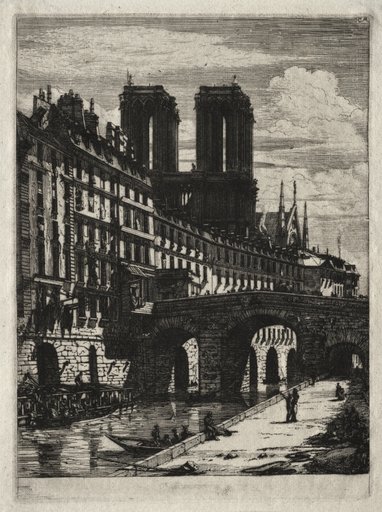
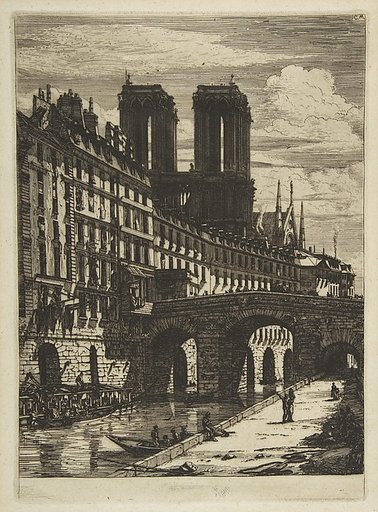
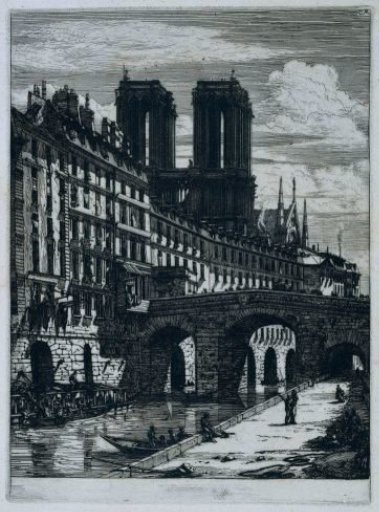
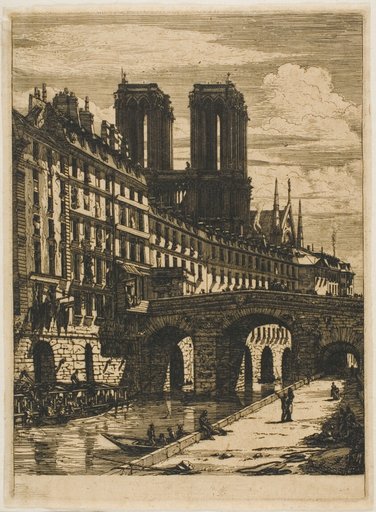
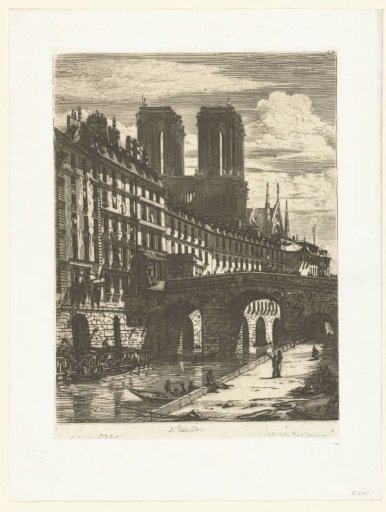
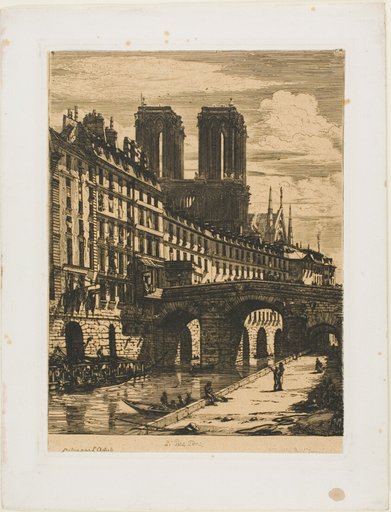
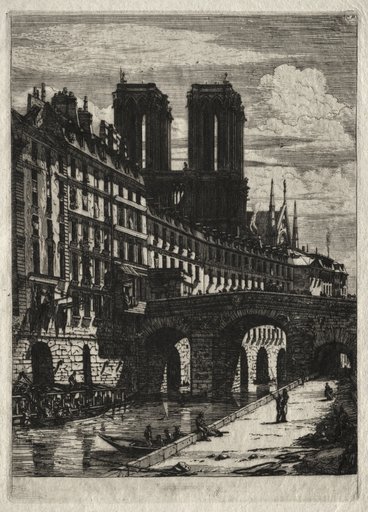
Although Meryon made the first study for this scene with a camera lucida (an apparatus containing a prism or an arrangement of mirrors that reflects the image on a surface so that its outlines may be traced), the artist then made changes to improve the composition—extending the height of the towers of Notre-Dame, for instance. Meryon did not mean his plates to have the precision of a photograph. Rather, he combined two views—a sketch from a low point at the water's edge and a view from the parapet—which, although not totally accurate, are believable. Charles Baudelaire (1821–1867) reported in a letter that he discussed this print with the artist who claimed "that the shadow cast by a portion of the stonework on the side wall of the Pont Neuf looked exactly like the profile of a sphinx; that this was entirely coincidence on his part and only later did he take note of this peculiarity."
Cleveland Museum of Art’s own description