CC0 · no rights reserved
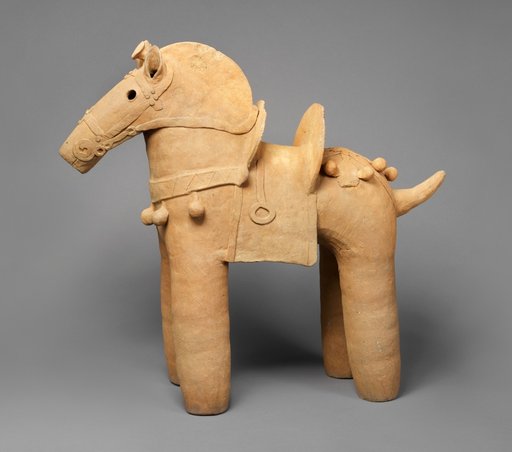
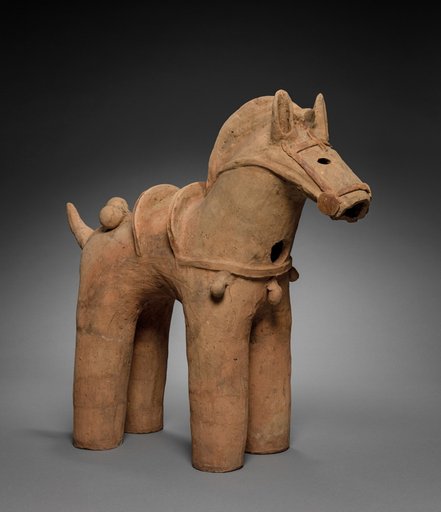
Haniwa Horse
From the collection of Cleveland Museum of Art. Free to download, adapt and use — no permission needed.
About this work
This horse’s tack, with its round bells, resembles saddlery in fashion in Korea during the 400s–500s CE. Concurrent with mass migration from the Korean Peninsula, tombs covered with large earthen mounds similar to those on the Asian continent began to appear in Japan around the year 300 CE. Called “old mounds” ( kofun ), their surfaces were covered with hollow clay cylinders ( haniwa ). Sculptures of animals, buildings, and finally human figures followed, developing over the ensuing three centuries.
Cleveland Museum of Art’s own descriptionCredit lineHaniwa Horse (馬形埴輪), 400s–500s CE. Japan, Kofun period (300–710 CE). Earthenware with traces of pigment; overall: 59.7 x 66 cm (23 1/2 x 26 in.). The Cleveland Museum of Art, The Norweb Collection, 1957.27