CC0 · no rights reserved
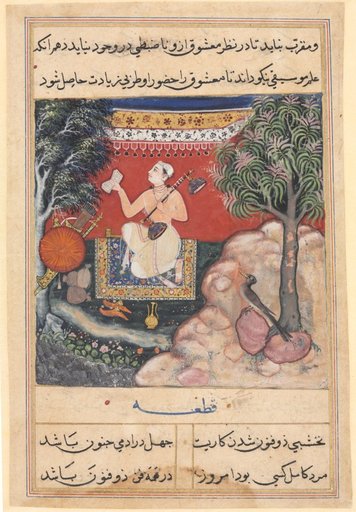
The origin of music from a fabulous bird of India which had seven holes in its beak, from a Tuti-nama (Tales of a Parrot): Fourteenth Night
From the collection of Cleveland Museum of Art. Free to download, adapt and use — no permission needed.
About this work
This story tells of a fantastical bird called a qaqnos who emitted sonorous tones from its beak when joyful. From these sounds, the science of music was developed. In the image, a man holding a book in one hand and an instrument called a vina in the other crouches beneath a tasseled canopy. His weapons, a quiver, sword, and shield hang in the tree nearby.
Cleveland Museum of Art’s own descriptionCredit lineThe origin of music from a fabulous bird of India which had seven holes in its beak, from a Tuti-nama (Tales of a Parrot): Fourteenth Night, c. 1560. Mughal India, court of Akbar (reigned 1556–1605). Gum tempera, ink, and gold on paper; overall: 20.2 x 14 cm (7 15/16 x 5 1/2 in.); painting only: 10 x 10 cm (3 15/16 x 3 15/16 in.). The Cleveland Museum of Art, Gift of Mrs. A. Dean Perry, 1962.279.110.b
Similar works
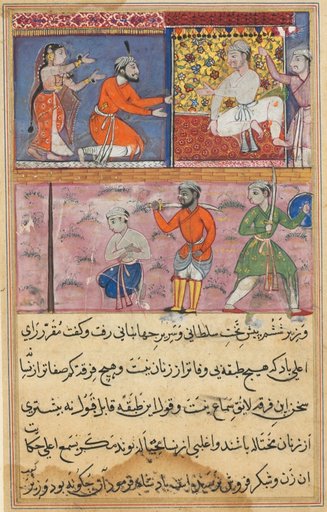 The prince sent back to the place of execution for the sixth time, from a Tuti-nama (Tales of a Parrot): Eighth Night
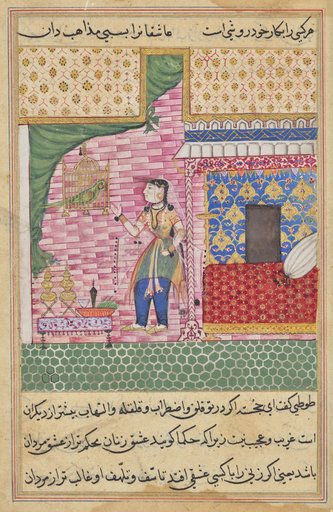 The Parrot Addresses Khujasta at the Beginning of the Seventeenth Night, from a Tuti-nama (Tales of a Parrot)
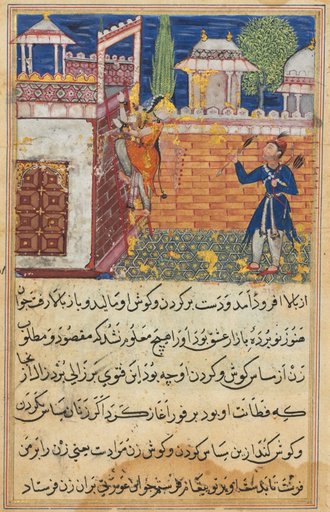 The deceitful wife returns to her terrace after caressing her lover, from a Tuti-nama (Tales of a Parrot): Eighth Night
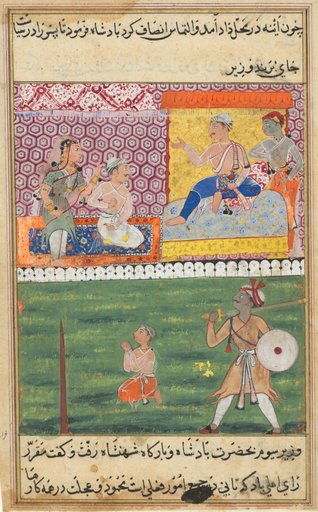 The handmaiden again appeals for justice and the prince is led to the place of execution for the third time, from a Tuti-nama (Tales of a Parrot): Eighth Night
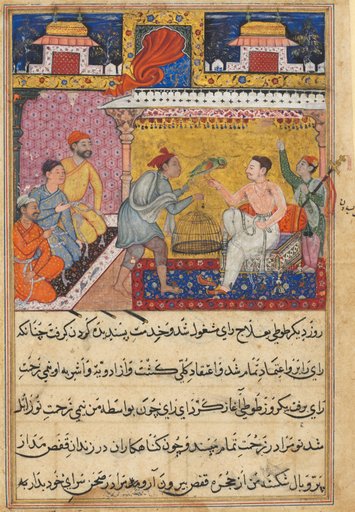 The hunter offers the mother parrot to the king of Kamarupa, from a Tuti-nama (Tales of a Parrot): Fifth Night
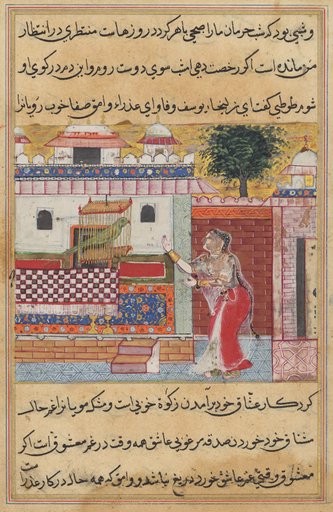 The Parrot Addresses Khujasta at the Beginning of the Twelfth Night, from a Tuti-nama (Tales of a Parrot)