CC0 · no rights reserved
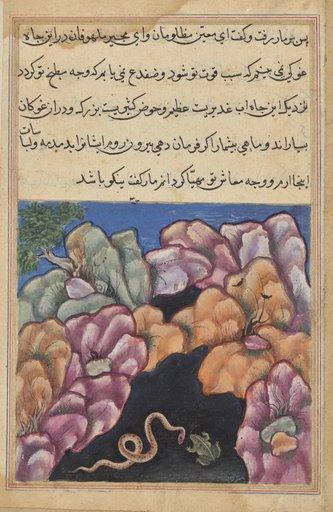
The snake enters into an argument with the frog, from a Tuti-nama (Tales of a Parrot): Twenty-sixth Night
From the collection of Cleveland Museum of Art. Free to download, adapt and use — no permission needed.
About this work
Cave compositions were replicated for multiple types of scenes in India, based on Persian models like the Shah-nama painting CMA 1988.96.a . The black background of the caves in the Tuti-nama provides the viewer a window into a subterranean space, the mouth of which is shown amid the rocks above. Shapur, the exiled frog tyrant, asked a snake to devour his enemies. However, when the snake became hungry again, he ate Shapur’s friends and family. Without any subjects to rule, the frog escaped his dangerous ally and lived out his life, sad and alone.
Cleveland Museum of Art’s own descriptionCredit lineThe snake enters into an argument with the frog, from a Tuti-nama (Tales of a Parrot): Twenty-sixth Night, c. 1560. Mughal India, court of Akbar (reigned 1556–1605). Gum tempera, ink, and gold on paper; overall: 20.3 x 14 cm (8 x 5 1/2 in.); painting only: 9.5 x 10.2 cm (3 3/4 x 4 in.). The Cleveland Museum of Art, Gift of Mrs. A. Dean Perry, 1962.279.183.b
Similar works
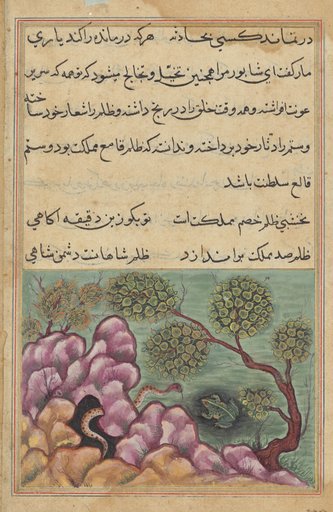 The dethroned frog Shapur seeks the help of the serpent, from a Tuti-nama (Tales of a Parrot): Twenth-sixth Night
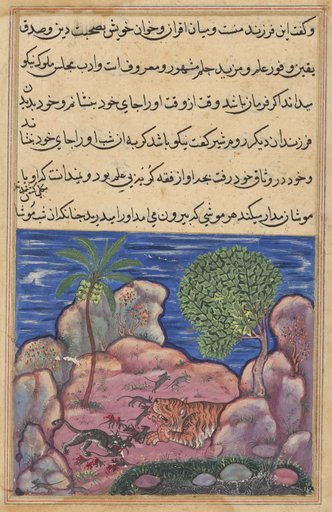 The cat attacks the mice which disturb the lion, from a Tuti-nama (Tales of a Parrot): Fifteenth Night
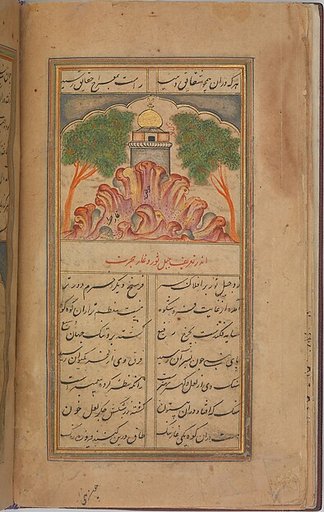 Futuh al-Haramayn (Description of the Holy Cities)
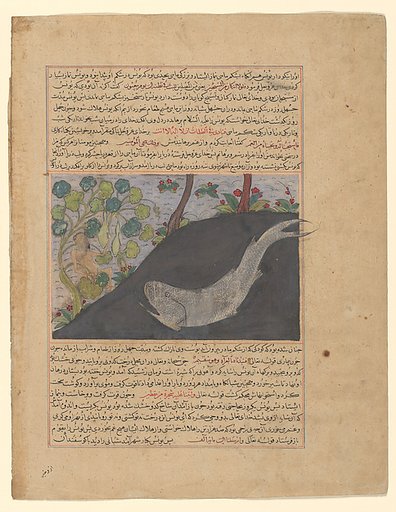 "Jonah and the Whale", Folio from a Majma' al-Tavarikh (Compendium of Histories) of Hafiz-i Abru
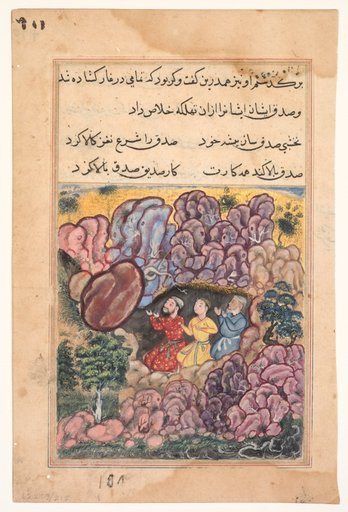 The tale of the three men trapped in a cave by a rolling boulder, from a Tuti-nama (Tales of a Parrot): Thirty-second Night
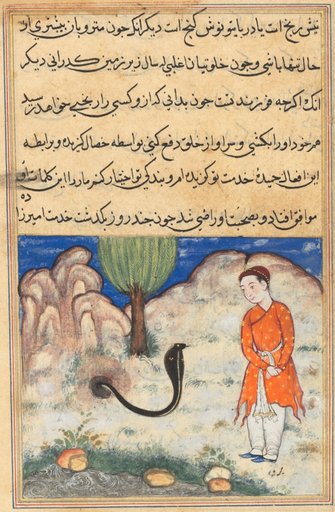 The prince, a son of the ruler of Sistan, enters the service of a snake, from a Tuti-nama (Tales of a Parrot): Thirty-seventh Night