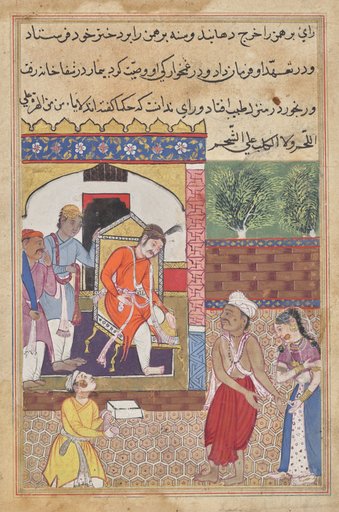
The magician, disguised as a Brahman, visits the king of Babylon, from a Tuti-nama (Tales of a Parrot): Thirty-fifth Night
From the collection of Cleveland Museum of Art. Free to download, adapt and use — no permission needed.
The king of Babylon, seated on a throne, receives the Brahman in the form of a woman and the magician in the form of a Brahman. The king agrees to keep the woman (the transformed Brahman) temporarily in his harem as a favor to the Brahman (the disguised magician). Scholars have identified this image as a portrait of Akbar, the third Mughal emperor of India, and the commissioner of this manuscript. He is thought to be identifying himself as the king of Babylon, regarded in the Islamic world as an ancient center of power and culture. In this story, however, the king fell victim to the trickery of his own daughter, her lover, and the magician, making one wonder why Akbar would choose to portray himself in this guise. The identification of this image as a portrait of Akbar remains unresolved.
Cleveland Museum of Art’s own descriptionSimilar works
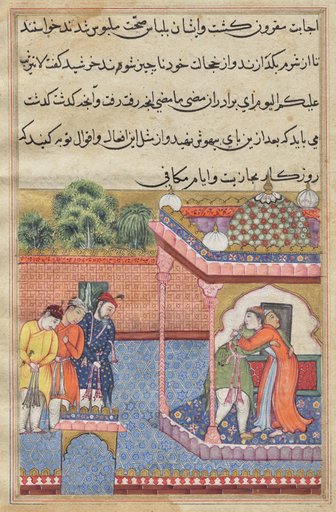 Khurshid reunited with her husband Utarid, from a Tuti-nama (Tales of a Parrot): Thirty-second Night
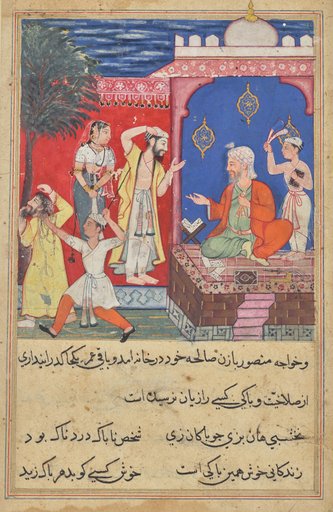 The false Mansur punished before the judge and expelled from the city, from a Tuti-nama (Tales of a Parrot): Seventeenth Night
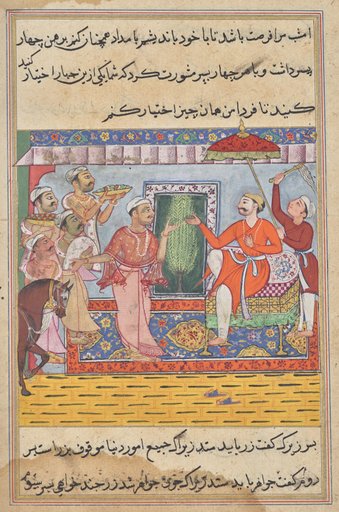 The Brahman, unable to select from the four gifts of the king of the Ocean seeks the Raja’s advice, from a Tuti-nama (Tales of a Parrot): Eleventh Night
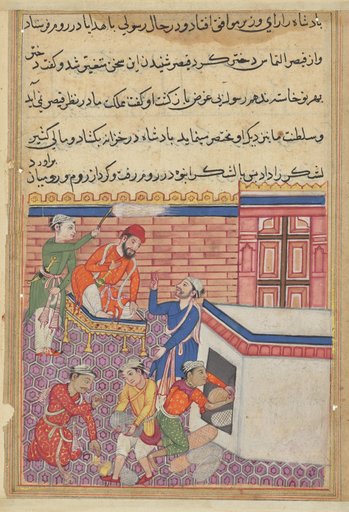 The king’s emissary being provided with gifts for his mission to Rum in order to seek the hand of the emperor’s daughter in marriage, from a Tuti-nama (Tales of a Parrot): Fiftieth Night
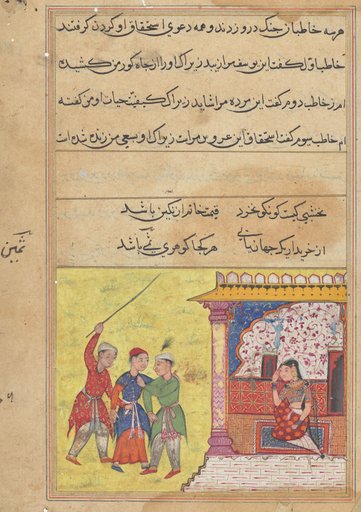 The three suitors again begin to quarrel among themselves for the hand of the devotee’s daughter, from a Tuti-nama (Tales of a Parrot): Twentieth Night
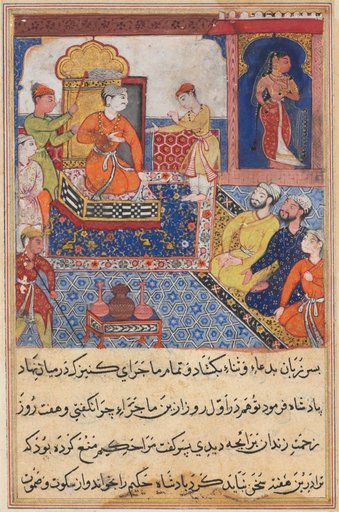 The young prince recounts his experiences to his father, the king, from a Tuti-nama (Tales of a Parrot): Eighth Night