CC0 · no rights reserved
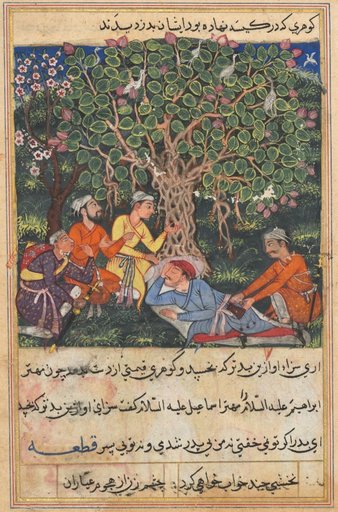
The street cleaner, on his way to meet King Bhojaraja, sleeps under a tree where four thieves disguised as fellow travelers deprive him of a priceless pearl, from a Tuti-nama (Tales of a Parrot): Twelfth Night
From the collection of Cleveland Museum of Art. Free to download, adapt and use — no permission needed.
About this work
Many scholars consider the diminutive Tuti-nama to have been one of the first illustrated manuscripts made for Akbar, on which Indian artists worked with Persian masters to formulate a new style that their exacting emperor appreciated. The new Mughal style would be used to create the monumental Hamza-nama and hundreds of other Mughal manuscripts. There are many continuities between the Tuti-nama and the Hamza-nama , such as the image of a recumbent figure under a magnificent tree.
Cleveland Museum of Art’s own descriptionCredit lineThe street cleaner, on his way to meet King Bhojaraja, sleeps under a tree where four thieves disguised as fellow travelers deprive him of a priceless pearl, from a Tuti-nama (Tales of a Parrot): Twelfth Night, c. 1560. Mughal India, court of Akbar (reigned 1556–1605). Gum tempera, ink, and gold on paper; overall: 20.3 x 14 cm (8 x 5 1/2 in.); painting only: 10.5 x 10.4 cm (4 1/8 x 4 1/8 in.). The Cleveland Museum of Art, Gift of Mrs. A. Dean Perry, 1962.279.97.a
Similar works
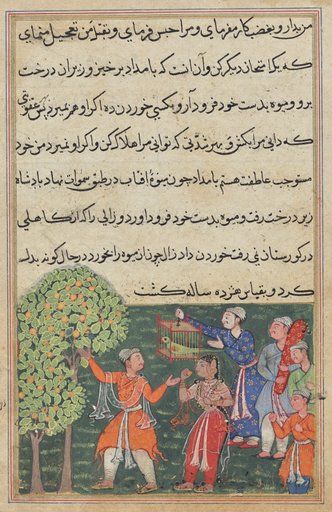 The king plucks fruit from the Tree of Life with his own hands and feeds it to a lady, from a Tuti-nama (Tales of a Parrot): Ninth Night
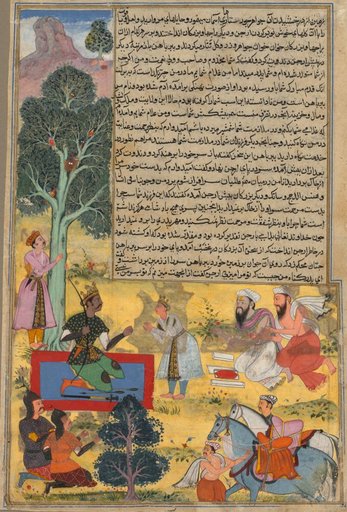 Vabhruvahana Approaches Arjuna, page from the Khan Khanan's Razm-nama
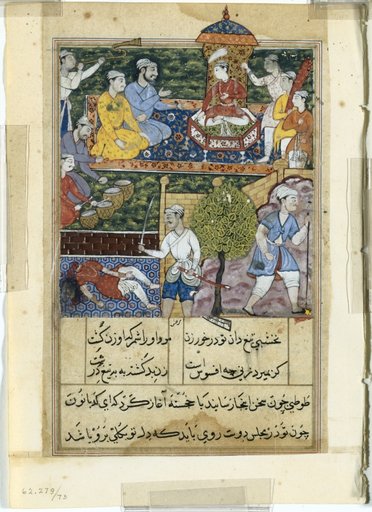 The young prince is crowned and the wicked handmaiden is executed, from a Tuti-nama (Tales of a Parrot): Eighth Night
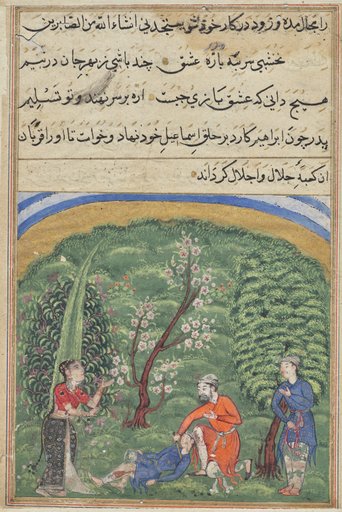 The sentinel in the employ of the Shah of Tabaristan prepares to sacrifice his son to the ghost of the Shah’s soul, from a Tuti-nama (Tales of a Parrot): Second Night
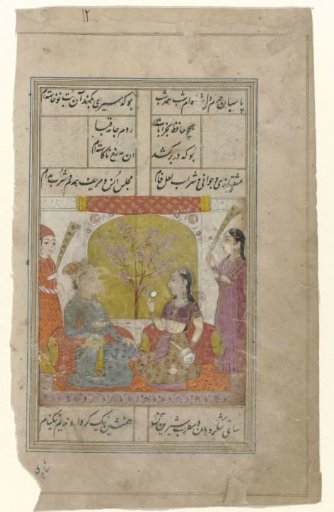 Couple on cushioned chairs in a palace with two maids behind them
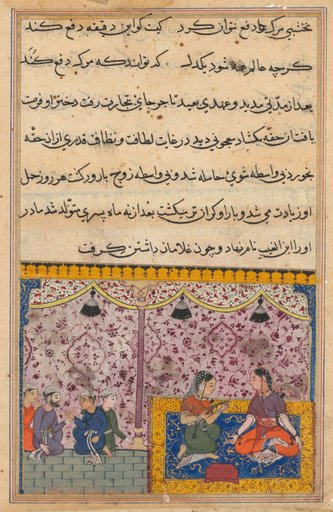 The merchant’s daughter gives birth to a son as a result of eating out of the box. The clever child recognizes the false gems from true, from a Tuti-nama (Tales of a Parrot): Twenty-third Night