CC0 · no rights reserved
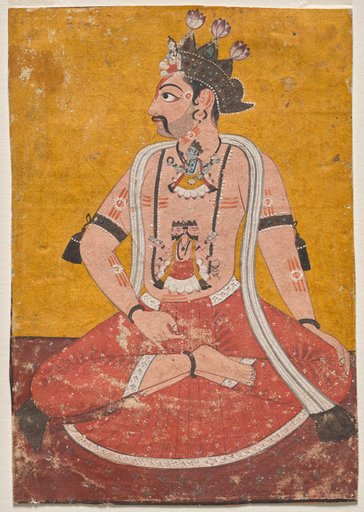
Man Dhata in Yogi Position
From the collection of Cleveland Museum of Art. Free to download, adapt and use — no permission needed.
About this work
An unconventional ruler portrait depicts Raja Mandhata of Nurpur (reigned 1661/1667–1700) engaged in yogic practice, raising his breath to pierce the three knots ( ghranti ) of the subtle body. The knots, which are located at the base of the spine, the heart, and between the eyebrows, are identified, respectively, with the deities Brahma, Vishnu, and Rudra (Shiva). This rare image of the ghranti points to the key role that kings played in creating yoga’s visual culture.
Cleveland Museum of Art’s own descriptionCredit lineMan Dhata in Yogi Position, c. 1690–1700. India, Pahari, Nurpur, late 17th Century. Gum tempera and ink on paper; overall: 20 x 14 cm (7 7/8 x 5 1/2 in.). The Cleveland Museum of Art, Edward L. Whittemore Fund, 1966.27