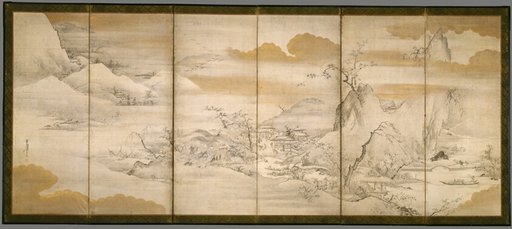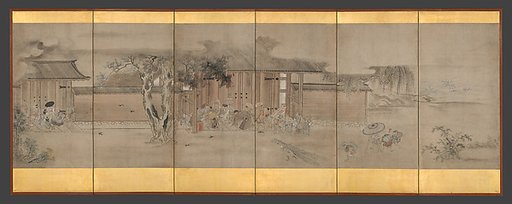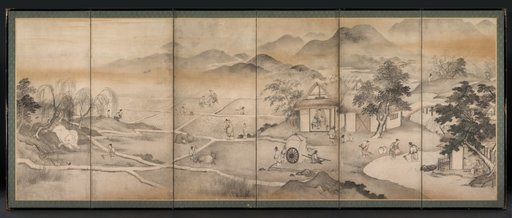
Emperor Yao Visiting Yu Chonghua
From the collection of Cleveland Museum of Art. Free to download, adapt and use — no permission needed.
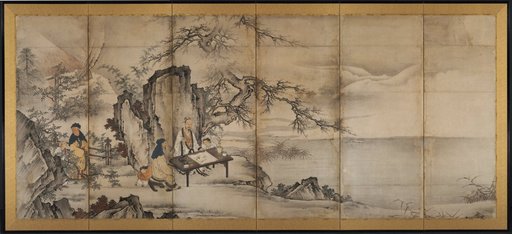
One of a pair, this screen shows a section of the narrative of how the Chinese Emperor Yao (about 2356–2255 BC) selected his successor, Yu Chonghua (about 2294– 2184 BC), who would become Emperor Shun. The artist who painted this screen, Kusumi Morikage, trained with Kano Tan’yō (1602–1647), painter-in-residence to Japan’s shogun, the country’s ruler, and was one of his four top students. Despite the conservative subject matter, Morikage’s distinctive sensibility shines through in his playful treatment of the gray and white elephants in the far left panel of the composition. According to legend, Chonghua was so virtuous that in the spring, elephants bounded down from the mountains to help him till the soil with their tusks.
Cleveland Museum of Art’s own description