CC0 · no rights reserved
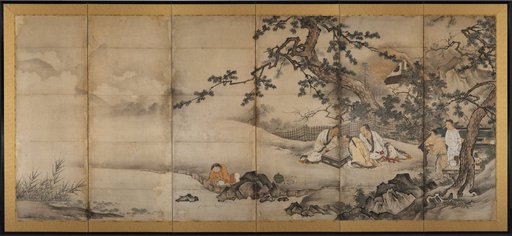
The Four Accomplishments
From the collection of Cleveland Museum of Art. Free to download, adapt and use — no permission needed.
About this work
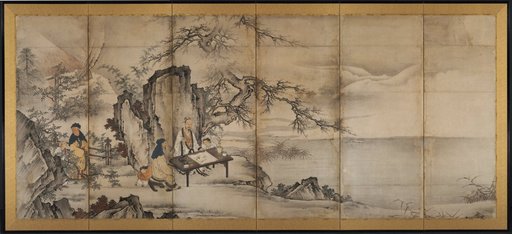
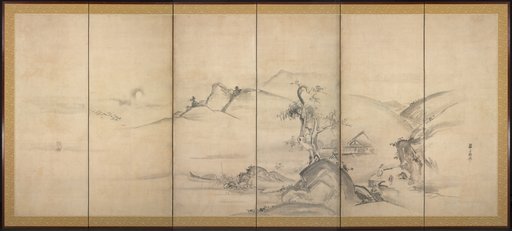
This is one of a pair of screens that shows a group of elite Chinese gentlemen and their servants in the countryside. One man looks on as two of his companions play a board game. Nearby is a table set with a selection of books and a qin , a type of stringed instrument, still wrapped in its cloth case, waiting to be played. The mood is one of enjoyment balanced with formality. Historically, playing the qin or qi (a game similar to chess called go in Japan), and practicing or admiring calligraphy were considered three skills essential for cultured men in China.
Cleveland Museum of Art’s own descriptionCredit lineThe Four Accomplishments (琴棋書画図屏風), late 1500s–early 1600s. Attributed to Kano Shōei (Japanese, 1519–1592). One of a pair of six-panel folding screens; ink and slight color on paper; painting: 153 x 358.6 cm (60 1/4 x 141 3/16 in.); mounted: 174 x 378.5 cm (68 1/2 x 149 in.). The Cleveland Museum of Art, John L. Severance Fund, 1979.46.1