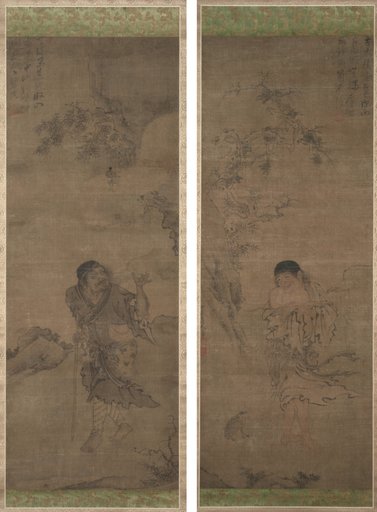
Li Tieguai; Liu Haichan
From the collection of Cleveland Museum of Art. Free to download, adapt and use — no permission needed.
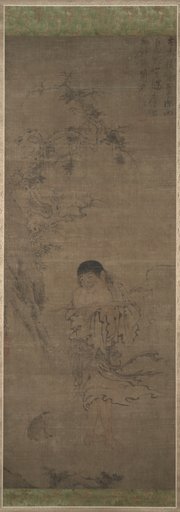
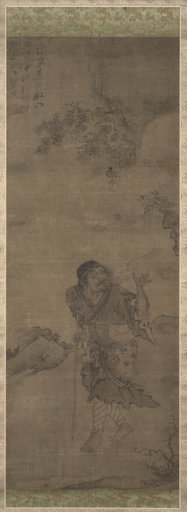
This pair of hanging scrolls show the Daoist immortals Li Tieguai and Liu Haichan. It is said that Li Tieguai’s ethereal self visited the deified Laozi but when he returned, he found that his own body was burned. He had to inhabit the corpse of a person who used a crutch to walk, and thus gained his name Tieguai—the Iron Crutch. The painting depicts Li Tieguai after he took possession of the body, with the iron staff in his hand. As Li exhales, he blows a small Li Tieguai in the air, showing the immortal’s ability to send his spirit on journeys. Liu Haichan is often shown as a young man wearing bangs across his forehead. He was said to have lived during the Five Dynasties period (907–979) and left his position as a grand councilor to become a hermit. Usually depicted carrying a string of coins and accompanied by a three-legged toad, Liu Haichan became a god of wealth and his toad symbolizes wealth as well.
Cleveland Museum of Art’s own description