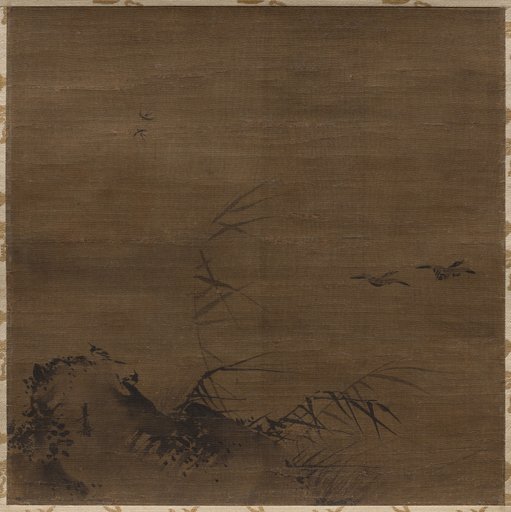
Waterfowl and Reeds
From the collection of Cleveland Museum of Art. Free to download, adapt and use — no permission needed.
This album leaf now mounted as a hanging scroll is attributed to the 13th-century artist Liang Kai, who served for a time in the Southern Song court as a court painter. In recognition of Liang’s outstanding talent, Emperor Ningzong (reigned 1195–1224) granted him the “Gold Belt,” the highest honor reserved for court painters. The artist, however, left his prestigious position in pursuit of the simple life in Buddhist monasteries. The so-called one-corner composition (leaving empty space on one side as the artist did here) was popular in both the imperial court and Buddhist monasteries. This distinctive composition allowed the artist to render a sense of space. Liang Kai’s abbreviated style and expressive monochromatic brushwork were often understood to embody ideals of Chan (Zen) Buddhism, and were continued by later Buddhist painters.
Cleveland Museum of Art’s own description