CC0 · no rights reserved
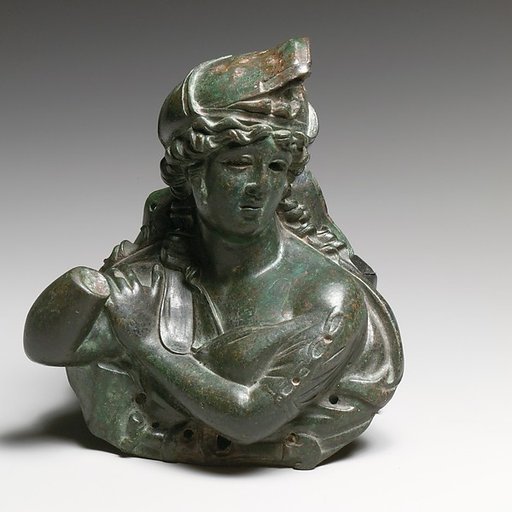
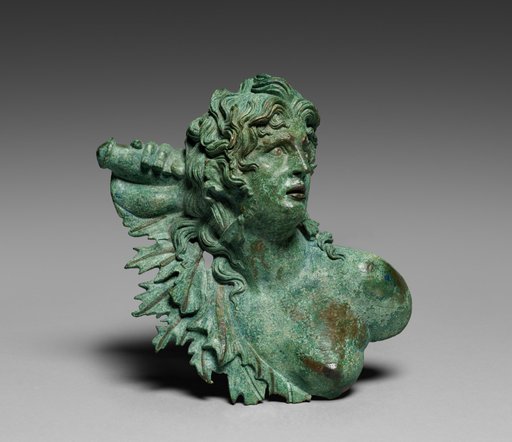
Tritoness or Scylla Relief Applique
From the collection of Cleveland Museum of Art. Free to download, adapt and use — no permission needed.
About this work
The seaweed garment, finned gills, and webbed ears give this female bust appliqué all the hallmarks of an ocean dweller. She may be a Tritoness, a minor goddess of the sea and the female counterpart to the more common Triton. However, her intense gaze and raised arm clutching perhaps the hilt of a sword suggest she may be Scylla, a sea monster that first appears in Homer’s Odyssey . Without the Tritoness’s fishtail or Scylla’s lower body made of dogs’ heads, it is difficult to differentiate. Certain features are highlighted with a copper inlay such as the lips, eyes, and gills.
Cleveland Museum of Art’s own descriptionCredit lineTritoness or Scylla Relief Applique, late 200s BCE. Greece, Hellenistic period. Bronze with copper inlays; overall: 22.4 x 24.5 x 7.8 cm (8 13/16 x 9 5/8 x 3 1/16 in.). The Cleveland Museum of Art, Leonard C. Hanna Jr. Fund, 1985.184