CC0 · no rights reserved
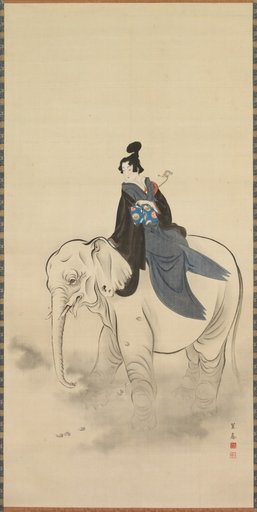
Stand-in Fugen
From the collection of Cleveland Museum of Art. Free to download, adapt and use — no permission needed.
About this work
Here, a woman dressed as a man replaces Fugen, a bodhisattva—a being among those considered enlightened in Buddhism—who symbolizes learning as a path to awakening and typically rides an elephant. The painting teaches the lesson of impermanence through the petals falling from the lotus flower the woman holds. It also alludes to the legend of Eguchi, a 12th-century courtesan who, following an encounter with a Buddhist monk-poet called Saigyō, revealed herself to be a manifestation of Fugen.
Cleveland Museum of Art’s own descriptionCredit lineStand-in Fugen (見立普賢菩薩図), late 1700s–early 1800s. Kitao Masayoshi (Japanese, 1761–1824). Hanging scroll; ink and color on silk; painting only: 114.3 x 56.2 cm (45 x 22 1/8 in.); including mounting: 186.7 x 76.2 cm (73 1/2 x 30 in.). The Cleveland Museum of Art, The Kelvin Smith Collection, given by Mrs. Kelvin Smith, 1985.277
Similar works
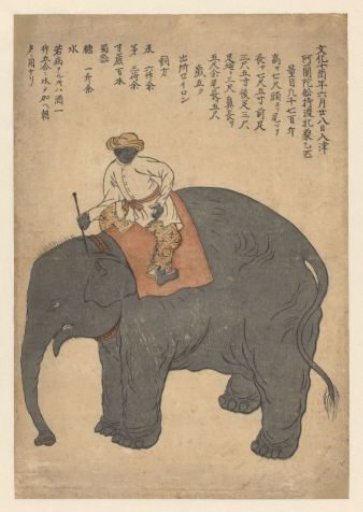 Elephant brought by a Dutch ship in 1813
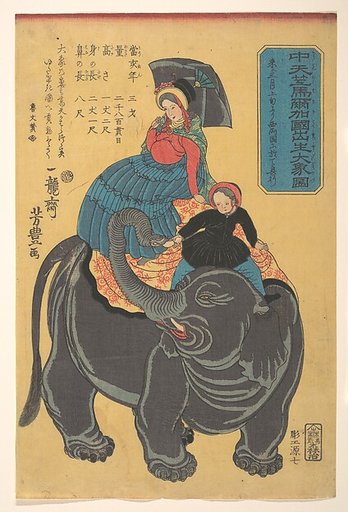 An Elephant from Baruka in Central India (Chū Tenjiku Barukakoku shūsshō daizō zu)
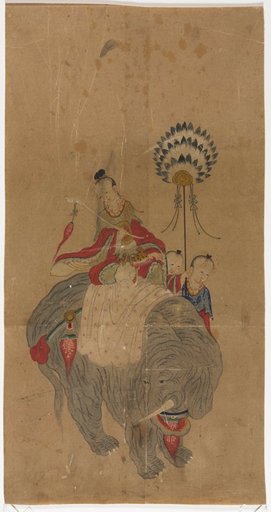 Samantabhadra on an Elephant with Two Attendants
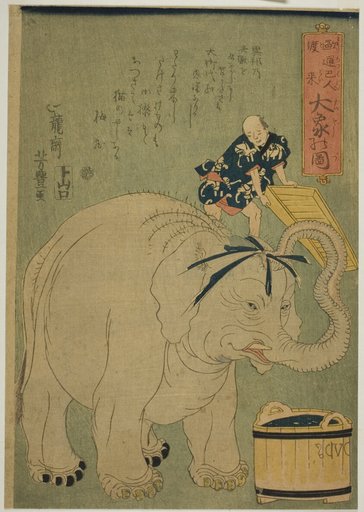 Arrival of the Europeans: The Great Elephant (Yoroppajin torai, Daizo no zu)
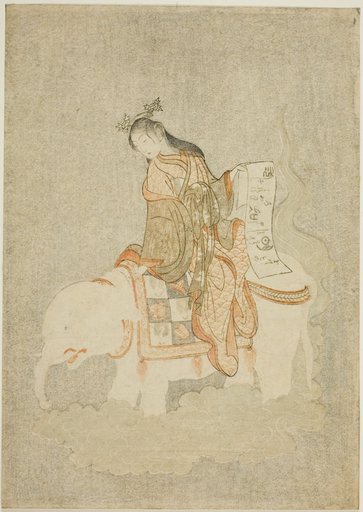 Courtesan on White Elephant
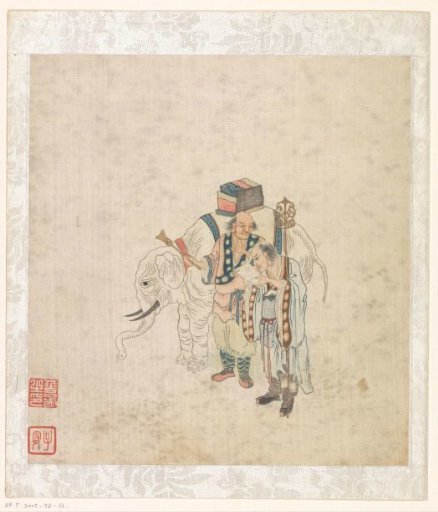 Two men beside an elephant with a stack of books on its back