CC0 · no rights reserved
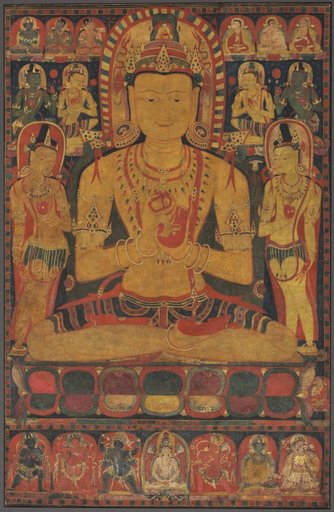
Tantric Buddha Vairochana as Vajrasattva
From the collection of Cleveland Museum of Art. Free to download, adapt and use — no permission needed.
About this work
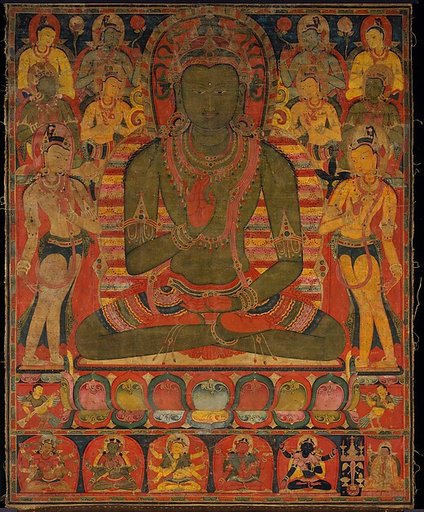
The seated Buddha dominating the composition is identified as Vairochana because of his hand gesture, the mudra communicating supreme enlightenment in which the index finger of one hand is grasped by the fingers of the opposite hand. His golden color and the tiny vajra —a six-pronged ritual object representing a thunderbolt—balanced on top of his finger suggest that he is in the guise of Vajrasattva, the summation of all enlightened beings. In his crown is the image of a monk, who is probably the guru of the donor, the small monastic figure at the lower right next to the lotus pedestal.
Cleveland Museum of Art’s own descriptionCredit lineTantric Buddha Vairochana as Vajrasattva, c. 1150–1200. Central Tibet. Gum tempera, ink, and gold on cloth; overall: 111 x 73 cm (43 11/16 x 28 3/4 in.). The Cleveland Museum of Art, Mr. and Mrs. William H. Marlatt Fund, 1989.104