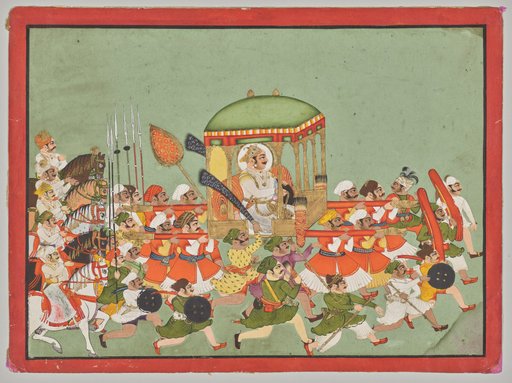
Maharao Chattar Sal (reigned 1758–64) of Kota in a Palanquin
From the collection of Cleveland Museum of Art. Free to download, adapt and use — no permission needed.
The king sits in his litter with a sun and moon disk behind his head, emphasizing the light of divine sanction for his rule. His power and grandeur seem to inspire his attendants to stride with effortless enthusiasm. Symbols of royalty abound in his retinue: cavaliers on horseback, spear bearers, soldiers with swords and daggers, attendants with peacock-feather fans, and archers carrying bows draped in red and quivers full of arrows. The small kingdom of Kota achieved independence in 1624, and its rulers, called rao (king) or maharao (great king) in the local dialect of Rajasthani, supported an atelier of artists at their court. Kota artists were known for dynamic and idealized portrayals of their rulers engaged in activities that emphasized the king’s supreme status.
Cleveland Museum of Art’s own descriptionSimilar works
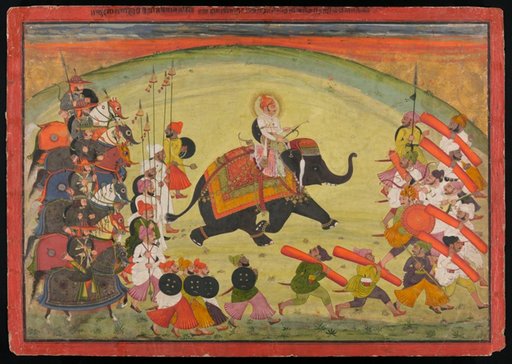 Maharao Guman Singh Riding an Elephant in Procession
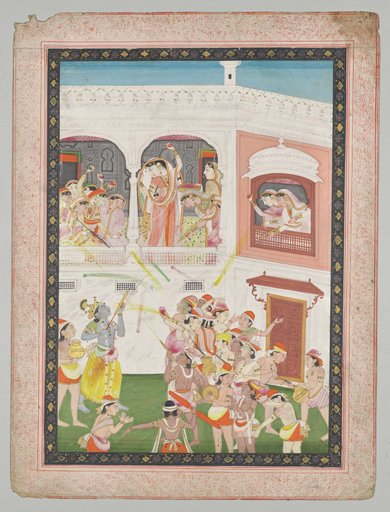 Radha and Hindu God Krishna celebrating the festival Holi
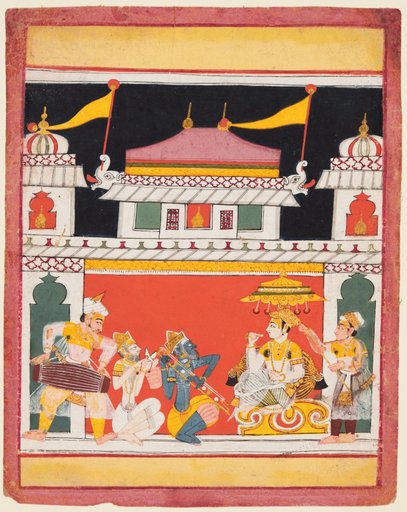 Three Musicians Perform Before a King: Shri Raga, from a Ragamala
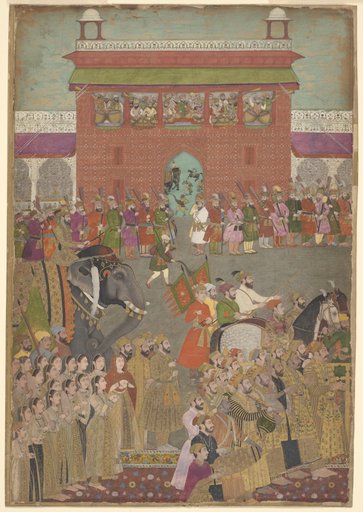 A Procession Scene with Musicians, from a copy of the Padshanama
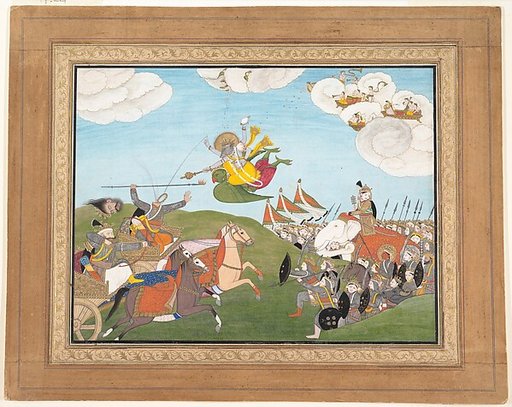 Vishnu as Varaha, the Boar Avatar, Slays Banasur, A Demon General: Page from an Unknown Manuscript
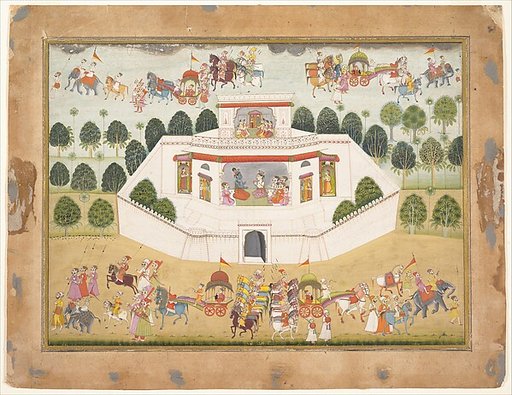 Krishna and Balarama within a Walled Palace: Page from a Dispersed Bhagavata Purana (Ancient Stories of Lord Vishnu)