CC0 · no rights reserved
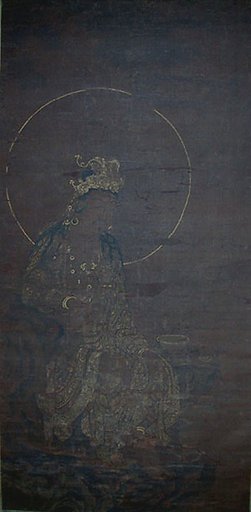
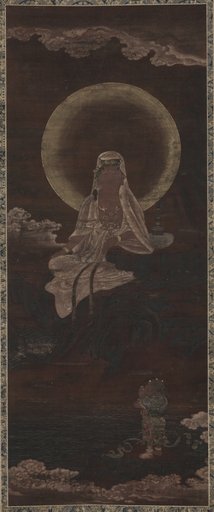
Water-Moon Kannon (Suigetsu Kannon)
From the collection of Cleveland Museum of Art. Free to download, adapt and use — no permission needed.
About this work
Kannon represents a primary figure of benevolence and compassion in the Buddhist pantheon. Identified early in Buddhist texts as a close attendant to the Buddha, by the 700s Kannon's popularity soared to such an extent in China, Korea, and Japan that the bodhisattva was often worshipped independently. Here at the lower left, Kannon is depicted with the child Zenzai Dōji (Sakskrit: Sudhana), a wealthy boy who, according to the final chapter of the Flower Garland Sutra , visited Kannon's abode Fudaraka (Sanskrit: Potalaka) during a long journey to learn the bodhisattva path.
Cleveland Museum of Art’s own descriptionCredit lineWater-Moon Kannon (Suigetsu Kannon) (水月觀音像), 1868–1912. Japan, Meiji period (1868–1912). Hanging scroll, ink, gold, silver, color, and cut gold-leaf on silk; painting: 104.5 x 41.9 cm (41 1/8 x 16 1/2 in.); overall with knobs: 188.9 x 64.8 cm (74 3/8 x 25 1/2 in.). The Cleveland Museum of Art, Mr. and Mrs. William H. Marlatt Fund, 1992.119