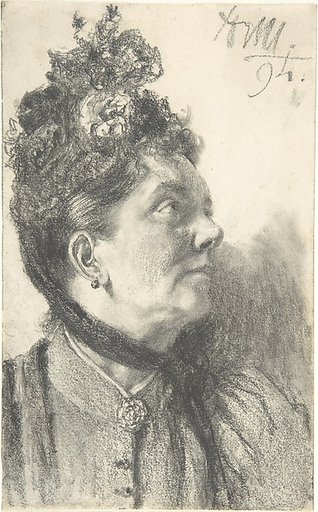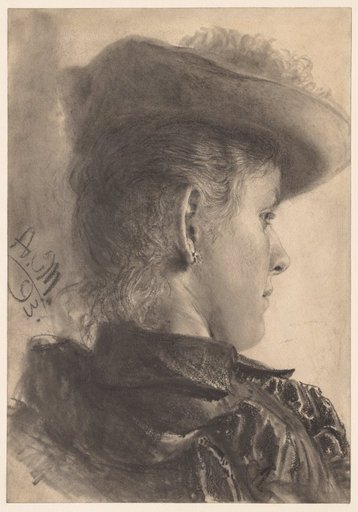
Bust of a Woman, Seen from Behind
From the collection of Cleveland Museum of Art. Free to download, adapt and use — no permission needed.
Adolph Menzel left more than 5,000 drawings created during a long and successful career that spanned the 19th century. Near the end of his life, when this drawing was made, he used a carpenter's pencil--a broad, flat-pointed lead pencil made of soft graphite--and stumping (rubbing with bits of tightly rolled paper or leather) to created numerous studies of heads of models that he considered independent works of art. In this drawing of a woman seen from behind from the shoulders up, the virtuosity of Menzel's stumping creates the effect of tangible surfaces and light falling on them, especially on the woman's face and hat. While he used the width of the pencil vigorously to indicate grainy black shadows in the folds of the coat and seat back, he used the sharp point for fine lines describing hair and facial features. The immediacy of the image--drawn in close proximity and capturing her mouth slightly open--suggests Menzel's focus on a fleeting moment. He wrote of drawings such as this as "true to nature" yet without "being copied from nature with fearful exactitude."
Cleveland Museum of Art’s own description