CC0 · no rights reserved
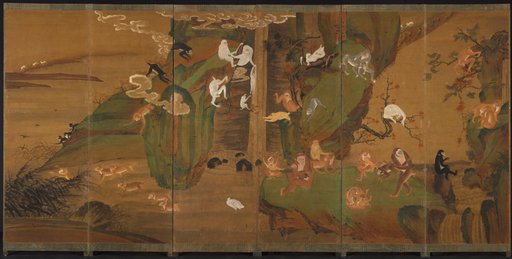
Gibbons in a Landscape
From the collection of Cleveland Museum of Art. Free to download, adapt and use — no permission needed.
About this work
In this folding screen, gibbons playfully interact with each other. In Korean paintings, gibbons were less frequently depicted than in their Chinese and Japanese counterparts. However, they became popular toward the end of the 1800s, possibly due to an influx of Chinese and Japanese decorative arts. Gibbons symbolize good fortune, but as paired with the red autumn foliage, specifically refer to professional success, such as passing the government examination and getting promoted to a higher position. The large ripe peach held by one gibbon bears another symbolic meaning: prosperity and longevity.
Cleveland Museum of Art’s own descriptionCredit lineGibbons in a Landscape (원숭이유희도 (群猿遊戱圖)), early 1900s. Korea, Joseon dynasty (1392–1910). Six-panel folding screen; ink and color on hemp; painting only: 104.8 x 393.7 cm (41 1/4 x 155 in.). The Cleveland Museum of Art, Leonard C. Hanna Jr. Fund, 1996.256