CC0 · no rights reserved
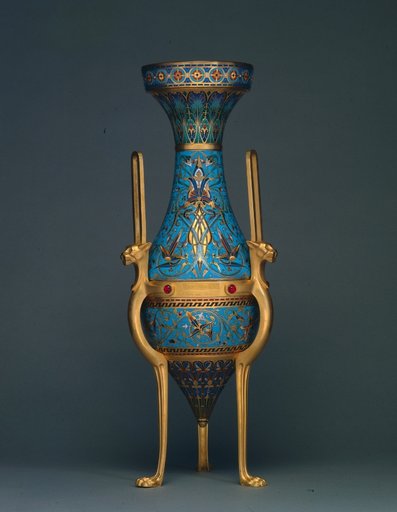
Vase
From the collection of Cleveland Museum of Art. Free to download, adapt and use — no permission needed.
About this work
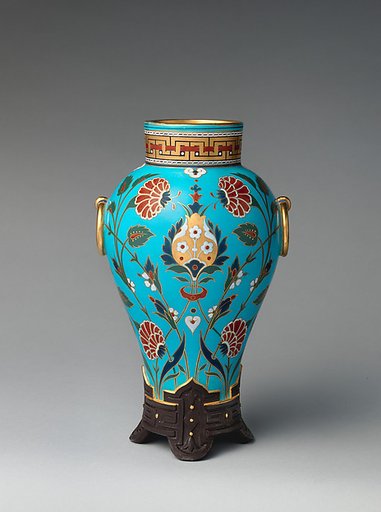
This vase vibrantly encapsulates the admiration for historical works of art and architecture that dominated the 1800s. It features stylistic qualities of ancient Egyptian, ancient Greek, and medieval Islamic art with its cat legs, amphora shape, and spiraling foliage ornamentation. The enameling technique itself, called champlevé, has roots in the ancient world. Champlevé enameling involves carving out sections of metal before filling those areas with colored enamel. The vase model was introduced at the International Exhibition of London in 1862, and its popularity resulted in several color and shape variations.
Cleveland Museum of Art’s own descriptionCredit lineVase, c. 1862. Firm of Ferdinand Barbedienne (French, 1810–1892), Louis-Constant Sévin (French, 1821–1888). Gilt bronze with enamel decoration; overall: 78.7 x 27.3 cm (31 x 10 3/4 in.). The Cleveland Museum of Art, The Severance and Greta Millikin Purchase Fund, 1996.295