CC0 · no rights reserved
Pilgrim’s Flask
From the collection of Cleveland Museum of Art. Free to download, adapt and use — no permission needed.
About this work
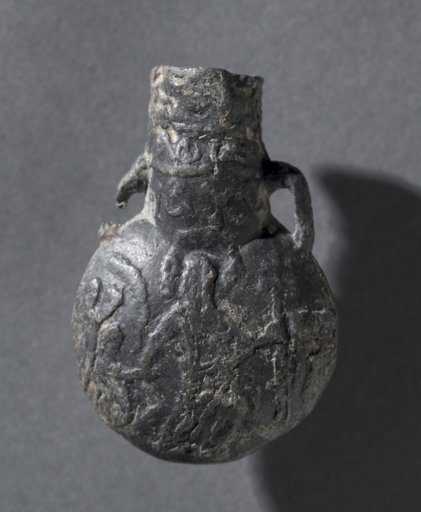
After the Crusader conquest of the Holy Land in 1099, Jerusalem experienced a revival of Christian pilgrimage. During the 12th century, the Church of the Holy Sepulcher was rebuilt, redecorated, and reconsecrated. With the influx of new pilgrims, especially from Western Europe, lead ampullae (small flasks) such as this very rare example were briefly reintroduced. The flask was cast with images of the Church of the Holy Sepulcher and Christ’s Descent into Limbo (Anastasis), establishing a visual connection with the holy sites of Christ’s death and entombment.
Cleveland Museum of Art’s own descriptionCredit linePilgrim’s Flask, c. 1099–1200. Byzantium, Latin Kingdom of Jerusalem, Palestine, Byzantine, Crusader Period, late 11th-12th Century. Lead; overall: 4.3 x 2.9 cm (1 11/16 x 1 1/8 in.). The Cleveland Museum of Art, Gift of Bruce Ferrini in memory of Robert P. Bergman, 1999.234