CC0 · no rights reserved
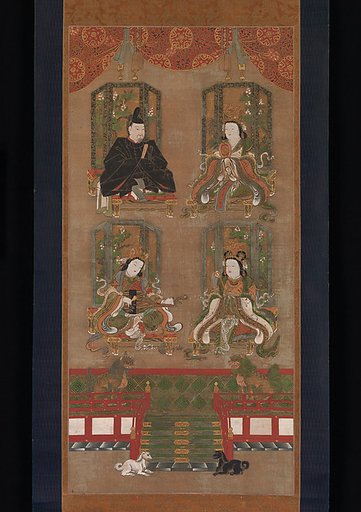
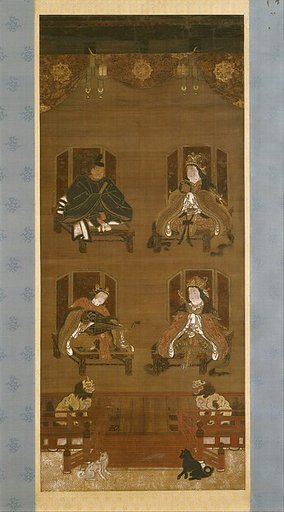
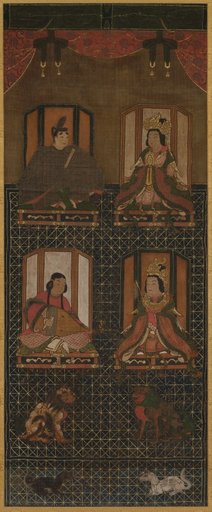
Mandala of the Four Deities of Mt. Kōya
From the collection of Cleveland Museum of Art. Free to download, adapt and use — no permission needed.
About this work
The two kami, or deities, at the top of this painting are Kariba Myōjin and Niu Myōjin. They inhabit Mount Kōya and are described as son and mother. They are shown here as courtiers, with Kariba in Japanese-style court robes and Niu in robes modeled after court garments of the Tang dynasty. The two kami seated beneath are Kehi Myōjin, portrayed as a lady holding a whisk, and the youthful Miyajima Myōjin, with his hair drawn up in loops, playing a lute ( biwa ). Hōjō Masako (1157–1225), the wife of the first Kamakura shogun (leader) Minamoto Yoritomo (1147–1199), invited them to Mount Kōya.
Cleveland Museum of Art’s own descriptionCredit lineMandala of the Four Deities of Mt. Kōya (高野四所明神像), 1500s. Japan, Muromachi period (1392–1573). Hanging scroll, ink, color and cut gold foil on silk; overall: 178.6 x 56.3 cm (70 5/16 x 22 3/16 in.); painting only: 97.5 x 39.3 cm (38 3/8 x 15 1/2 in.). The Cleveland Museum of Art, Gift of Rosemarie and Leighton Longhi, 1999.262