The Disrobing of Christ
From the collection of Cleveland Museum of Art. Free to download, adapt and use — no permission needed.
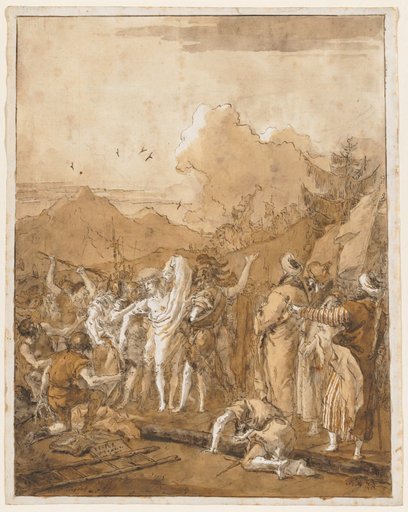
Giovanni Domenico Tiepolo, an important Venetian fresco painter of the 18th century, is best known today for his highly finished historical drawings that ingeniously incorporate details from daily life. This drawing, from a suite of more than 260 sheets known as the Large Biblical Series , depicts the Disrobing of Christ (the tenth Station of the Cross). A trio of patriarchs watch as Roman soldiers strip Jesus of his robe, a mob brews in the background, and over the lip of the hill, Roman soldiers trumpet the Crucifixion. The figure of Jesus, who glows with the stark white color of Domenico’s exposed paper, emerges simple and luminous from the chaos around him. His hammer-wielding executioner, emphasized with golden-brown wash, kneels before him—an ironic touch that implies the religious significance of Christ’s death. Domenico's signature technique, seen here, includes an underdrawing in black chalk or charcoal, contour lines drawn with a quill pen and brush, and modeling with a range of brown washes. His gestural, agitated lines evoke a strong sense of movement and emotional tension. The artist likely made the series for his own edification rather than for sale, as he kept the drawings during his lifetime and no prints were made.
Cleveland Museum of Art’s own description