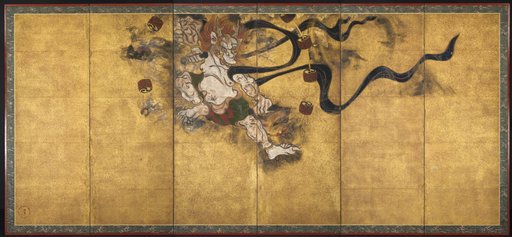
God of Thunder (Raijin)
From the collection of Cleveland Museum of Art. Free to download, adapt and use — no permission needed.
Such depictions of the God of Thunder originated in Buddhist art. Here, the image was painted on paper covered with gold dust, a technique often found in paintings by Tawaraya Sotatsu or of the Sotatsu school. This gold technique and the "Inen" seal here suggest that the anonymous painter of this screen was probably associated with the Sotatsu workshop. The artist used a prototype borrowed from earlier Japanese narrative painting—rather than mechanically reproducing Sotatsu’s image—and created a bold, innovative image that served the world of play and leisure in early Edo Japan. The theme of "God of Thunder" was often paired with "God of Wind" and has been frequently reinterpreted by generations of Rimpa artists. Unfortunately, the screen God of Wind which would have accompanied this God of Thunder cannot be located.
Cleveland Museum of Art’s own description