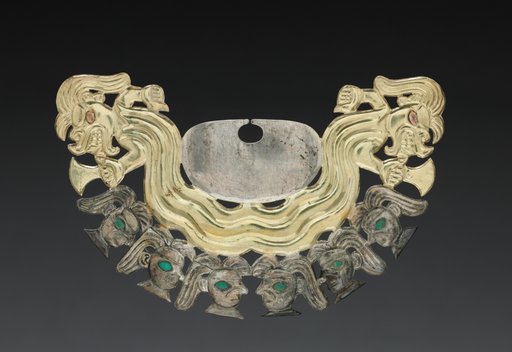
Nose Ornament with Decapitators and Human Heads
From the collection of Cleveland Museum of Art. Free to download, adapt and use — no permission needed.
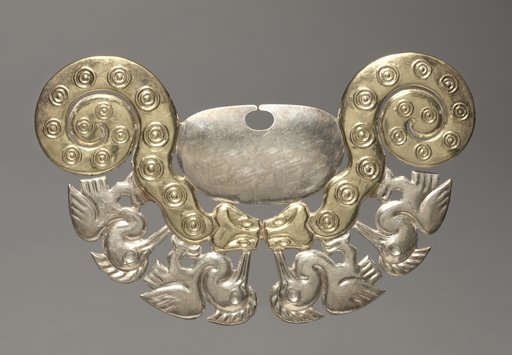
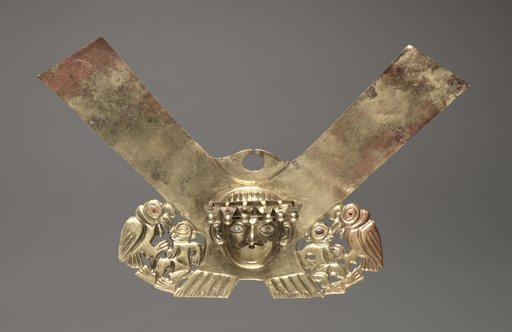
A crucial element of Moche royal regalia was the nose ornament, whose imagery varies from benign to predatory. One ornament here depicts a human head, perhaps a ruler’s portrait, flanked by birds that attack human victims. In another, two supernatural decapitators brandish knives over a row of severed human heads. The third is an elegant composition that combines serpents with long-necked water birds. The Moche were among the Andes’ most inventive metalsmiths, and they developed many complex techniques for joining and enriching the surfaces of metals, which they usually worked by hammering rather than casting. The gold-and-silver ornaments were made by first joining gold and silver sheets through heating and hammering. Then came the relief decoration, followed by the selective removal of metal along the joins. Finally, the ornament was trimmed and polished.
Cleveland Museum of Art’s own description