Tiger Hunt of Raja Ram Singh II
From the collection of Cleveland Museum of Art. Free to download, adapt and use — no permission needed.
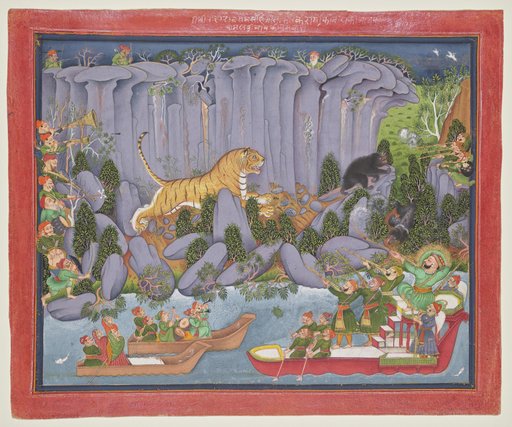
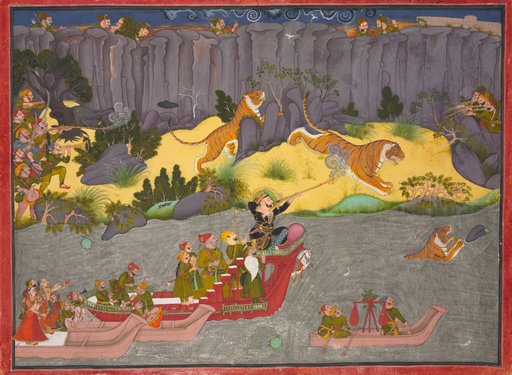
With the dramatic cliffs of Kotah as the backdrop, one massive tiger is shown at three rapidly successive moments in time. Having been lured out of the forest by the dead bull at the upper left, the king’s men drive the tiger to the riverbanks with drums, trumpets, arrows, and muskets. The king himself, Ram Singh II who ruled the small kingdom of Kotah from 1827 until 1866, is shown in the act of delivering the fatal shot from the prow of a boat, as the ladies and nobles of the court look on in admiration. The tiger sinks into the river, from where he will be retrieved and offered with all honor and ceremony to a religious leader who will see to it that the shakti, or divine creative energies embodied by the tiger, be translated into blessings and prosperity for the kingdom. This example of a ritual tiger hunt belongs to a genre known as Rajput painting, made at the courts of kingdoms in Rajasthan that were under the aegis of the Mughal empire. The establishment of court painting workshops in the Rajput kingdoms was inspired by the imperial Mughal model, but each court developed its own distinctive style.
Cleveland Museum of Art’s own description