One of a Pair of Decorated Palanquin Hooks and Rings
From the collection of Cleveland Museum of Art. Free to download, adapt and use — no permission needed.
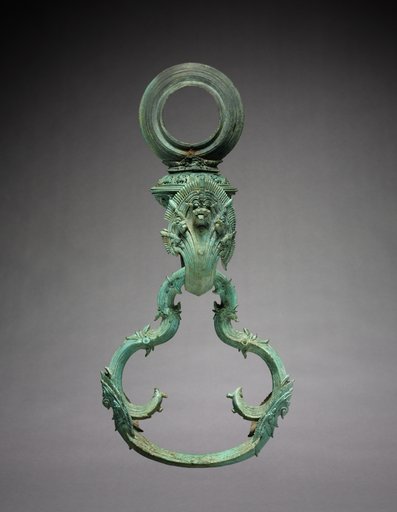
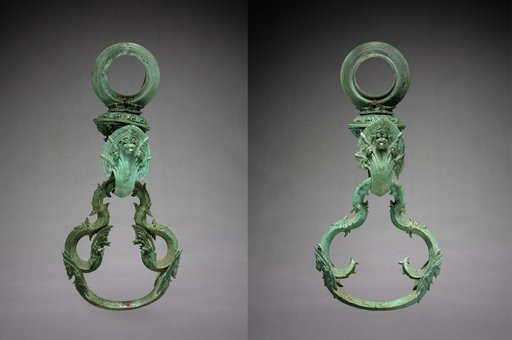
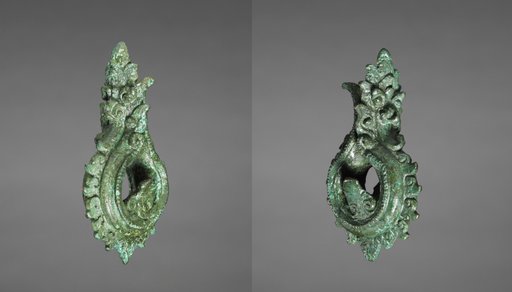
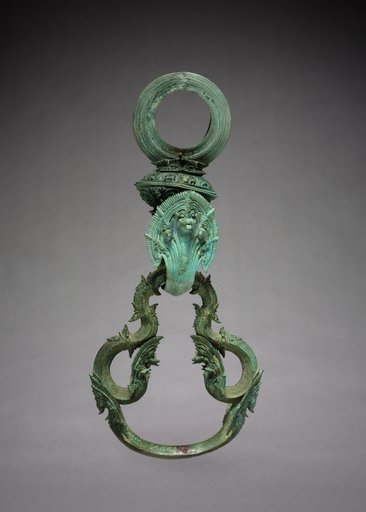
Hooks, suspension rings, and finials cast in bronze are very common fixtures in Cambodian decorative art. Frequently they served a practical function, such as the present set, used for a palanquin in which a person was carried from place to place. The litter or throne was fastened to the rings which in turn were suspended from the books fixed by bolts to transverse poles carried on the shoulders of the palanquin bearers. Chariots, palanquins, furniture, and harnesses were frequently embellished with various bronze decorations, finials, and fixtures. Those, as a rule, were gilded making the objects they served look very sumptuous. The relief sculpture found on various Khmer monuments, such as Angkor Wat or Bayon for instance, illustrates well the use and context of those bronze implements in ancient Cambodian life. These frequently elaborate bronze fixtures were decorated with motifs generally popular in Cambodian art: such as nagas, garudas, floral, or animal patterns. This pair of hooks and rings, unusually large in size, take on a naga form in the hooks. They are decorated with perforated floral and animal motifs done with great care and precision. The rings, suspended from hooks, are in the form of tri-fold flower stalks with naga motifs repeated at the end of the curved stalks. Such elaborate and huge hooks and rings must have, no doubt, decorated a palanquin of an important individual, possible a ruler himself. Their decoration is typical of the mature Angkor Wat style.
Cleveland Museum of Art’s own description