Hevajra
From the collection of Cleveland Museum of Art. Free to download, adapt and use — no permission needed.
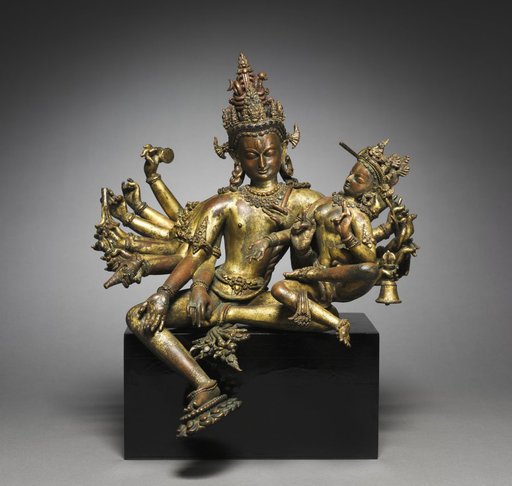
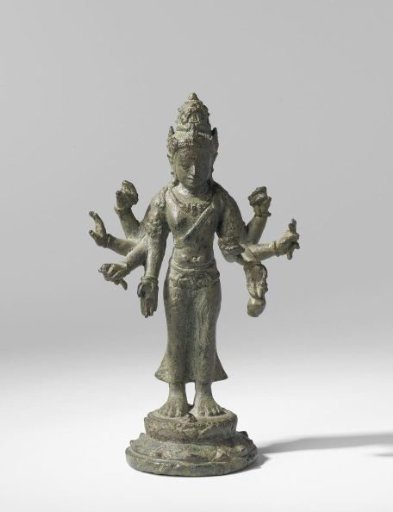
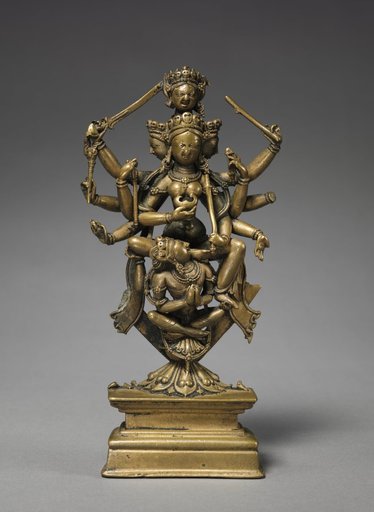
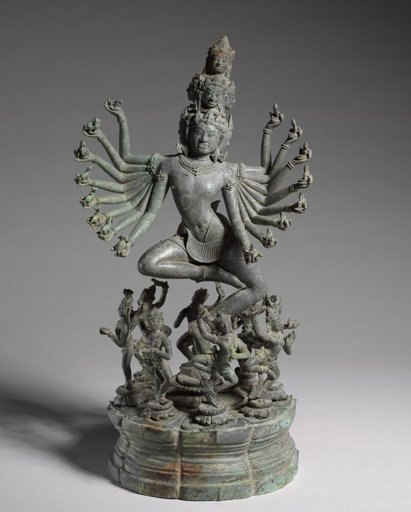
Hevajra was an important figure signaling the practice of Buddhist rituals. King Jayavarman VII placed particular emphasis on Hevajra during consecration rituals and set up a colossal stone sculpture of dancing Hevajra at the east gate of his fortified city in the Khmer capital at Angkor. In the Cambodia of Jayavarman VII, tantric Buddhism became public and widespread, practiced together with other more mainstream forms of Buddhism, Hinduism, and ancestor worship. The iconography of Hevajra is described in detail in a text that bears his name, the Hevajra-tantra , first composed in India probably in the 800s. Hevajra has eight heads, sixteen arms, and four legs. His left hands hold images of Indic gods; wealth, death, sun, moon, fire, wind, water, and earth. In his right hands are animals: bull, lion, human, cat, camel, sheep, horse, and elephant. They all sit in skull cups, objects also used in tantric rituals. He dances on a corpse that embodies ignorance and is surrounded by eight yoginis who dance triumphantly in a ring around him. Yoginis functioned as intercessors between human practitioners and enlightened beings. Many bronze images of Hevajra were made during the reign of Jayavarman VII, but few survive in as pristine condition as this example. According to scientific analysis and curatorial reports, this sculpture survived in a clay vessel submerged in water, which accounts for its high tin content and unusual gray patina. Samples from the clay core reveal the presence of the mineral feldspar, a characteristic of clay from the Isaan plateau, on the other side of the mountain range not far from Banteay Chhmar, in present-day Thailand.
Cleveland Museum of Art’s own description