CC0 · no rights reserved
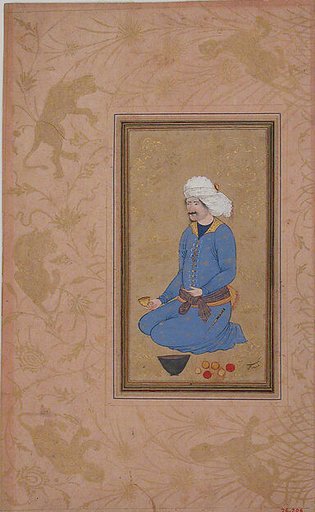
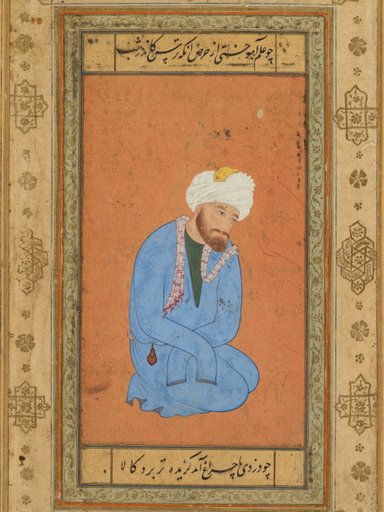
Portrait of a kneeling holy man, from the Prince Salim Album
From the collection of Cleveland Museum of Art. Free to download, adapt and use — no permission needed.
About this work
The kneeling figure is a charlatan holy man who wears the blue robe of a Sufi mystic. According to the inscriptions above and below the painting, he acts humble and pious for monetary gain rather than sincerity of devotion. Images of charlatan holy men recur in Mughal painting, including in the Cleveland Tuti-Nama . Mir Sayyid Ali was the first head of the Mughal workshop under Akbar. He was responsible for training Indian artists to adopt Persian sensibilities, admired by elites of the Islamic world during the 1400s to at least the 1700s.
Cleveland Museum of Art’s own descriptionCredit linePortrait of a kneeling holy man, from the Prince Salim Album, c. 1556–60; border c. 1602. Attributed to Mir Sayyid Ali (Persian, active in Iran 1540s–50, active in India 1555–1580). Gum tempera, ink, and gold on paper, laid down on an album page with cream borders decorated with gold flowers and geometric motifs; painting: 12 x 7.1 cm (4 3/4 x 2 13/16 in.); overall: 23.3 x 14.9 cm (9 3/16 x 5 7/8 in.). The Cleveland Museum of Art, Gift in honor of Madeline Neves Clapp; Gift of Mrs. Henry White Cannon by exchange; Bequest of Louise T. Cooper; Leonard C. Hanna Jr. Fund; From the Catherine and Ralph Benkaim Collection, 2013.295