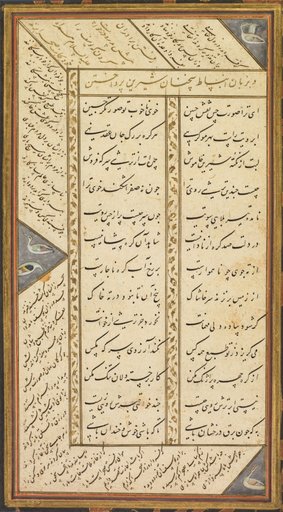
Page from the Panj Ganj (Five Treasures) of Abd al-Rahman Jami (Persian, 1414–1492), with two Persian masnavis (narrative poems): Yusuf va Zulaykha (Joseph and Zulaykha) and Subhat al-abrar (Rosary of the Righteous)
From the collection of Cleveland Museum of Art. Free to download, adapt and use — no permission needed.
The recto of this album page contains two different texts, one written diagonally in the border and the other in the two central columns. The section of poetry in the border describes an episode from Joseph’s childhood in which his older brothers suggest to Jacob, their father, that they take Joseph into the countryside so that the boy can learn the area, although they actually plan to kill him. The poem in the central columns advises the reader to smile often, as a smile is sweeter and more pleasing than sugar. This page is from a prized manuscript owned by one of the most respected statesmen of the imperial Mughal court, Abd al-Rahim. He served as the Khan Khanan, or vizier, the trusted minister under both Akbar and Jahangir. Abd al-Rahim was an avid book collector and patron of the arts. He acquired this book of five extended narrative poems, which included the story told in rhyme of the romance between Joseph and the Egyptian lady Zulaykha, about 80 years after its completion. The book’s illumination had not been finished, so Abd al-Rahim commissioned the exuberant decor of the borders and insets along with full-page paintings that illustrate key scenes in the text.
Cleveland Museum of Art’s own descriptionSimilar works
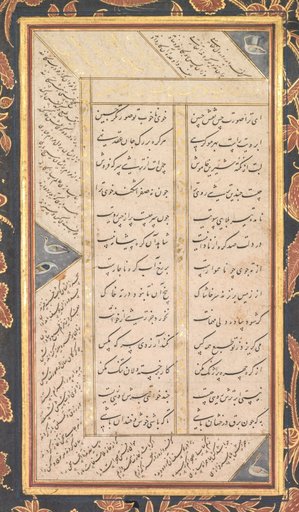 Folio B: Folio from the "Five Treasures" (Panj Ganj) of Jami (recto)
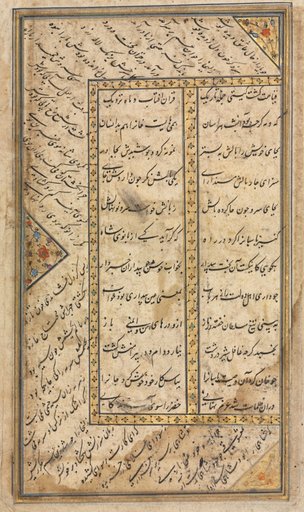 Persian verses from a Haft Awrang (Seven Thrones) of Jami (d. 1492) (recto)
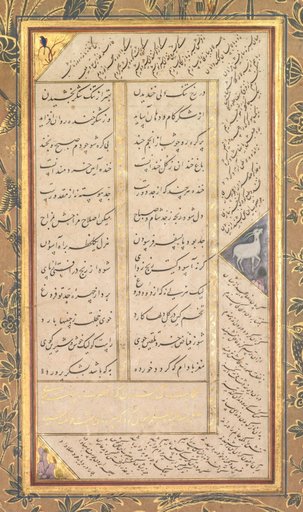 Page from a Panj Ganj (Five Treasures) of Abd al-Rahman Jami (Persian, 1414–1492), with two Persian masnavis: Yusuf va Zulaykha (Joseph and Zulaykha) and Subhat al-abrar (Rosary of the Righteous) (verso)
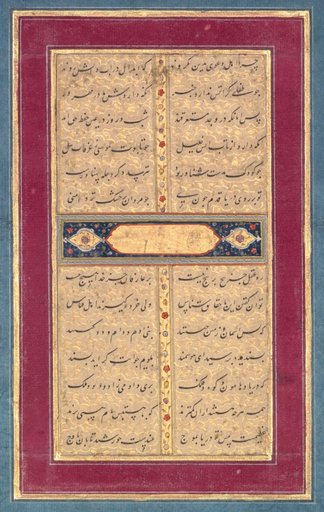 Calligraphy: A Page of Text from Sadi's Bustan (verso)
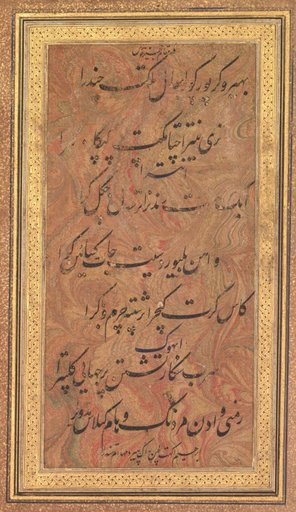 Eight Lines of Musical Poetry of the Jajner Nauras (Rag Bhairav) of Ibrahim Adil Shah of Bijapur (verso)
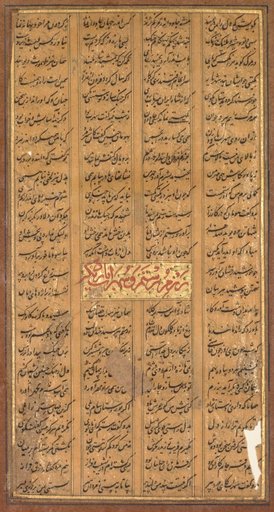 Text of Rustam and Suhrab, from the Shah-nama of Firdausi (Persian, c. 934–1020) (verso)