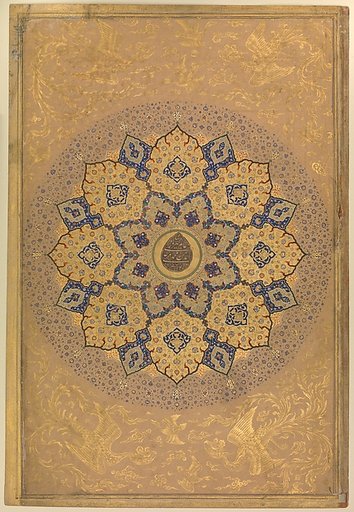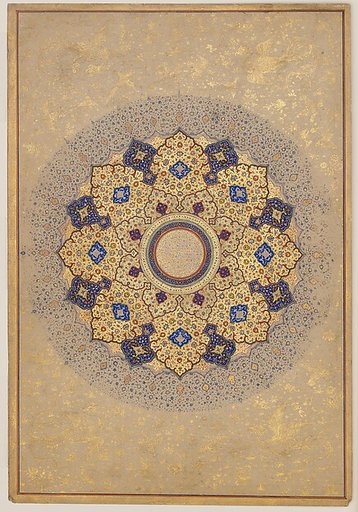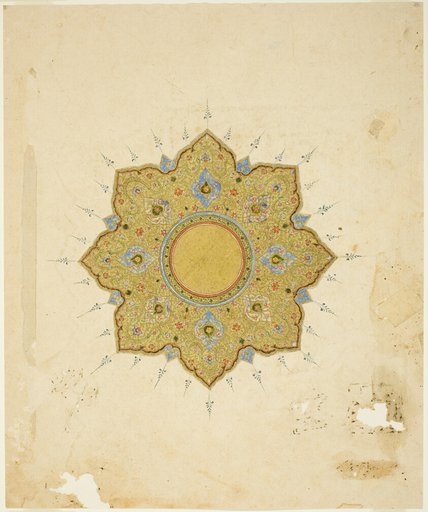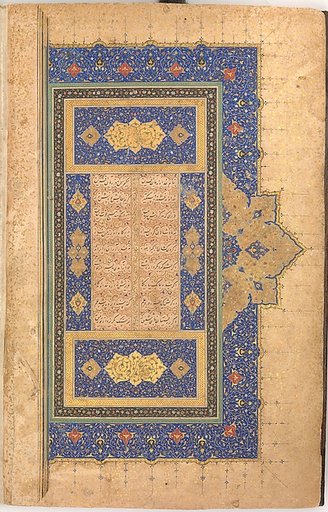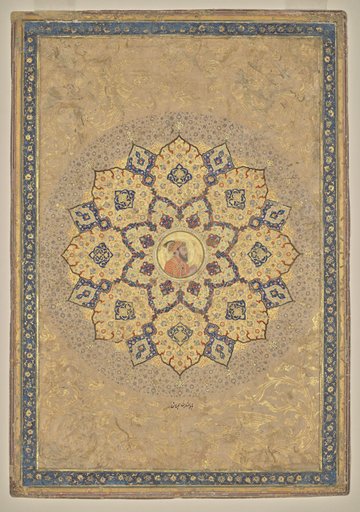
Shamsa (sunburst) with portrait of Aurangzeb (1618–1707), from the Emperor's Album (the Kevorkian Album)
From the collection of Cleveland Museum of Art. Free to download, adapt and use — no permission needed.
This closing page of an imperial Mughal album originally had the shamsa , or sunburst, with a plain gold disc in the center, referencing the light of God as divine sanction for Emperor Shah Jahan’s rule. The depiction of divine light by means of floral and geometric patterns was painted by hand with mathematical precision in gold and lapis lazuli. The portrait of Aurangzeb was probably added when he took over the imperial library after seizing the throne from his father, Shah Jahan, in 1658 and adopting the name Alamgir, which means “Seizer of the Universe.” The string of prayer beads in his right hand points to his extreme religious orthodoxy, which dramatically altered the culture of the Mughal court from what had previously been an openly ecumenical center.
Cleveland Museum of Art’s own description