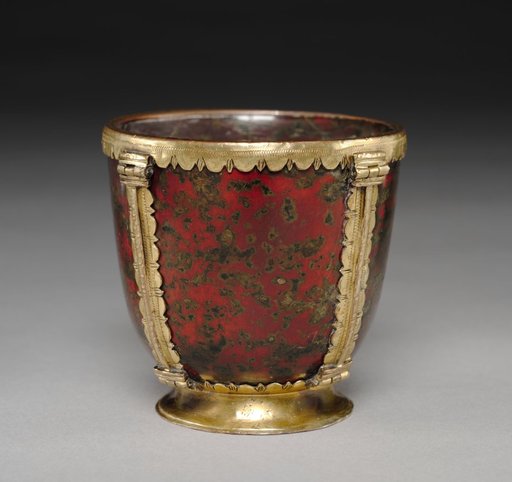
Calyx (Chalice)
From the collection of Cleveland Museum of Art. Free to download, adapt and use — no permission needed.
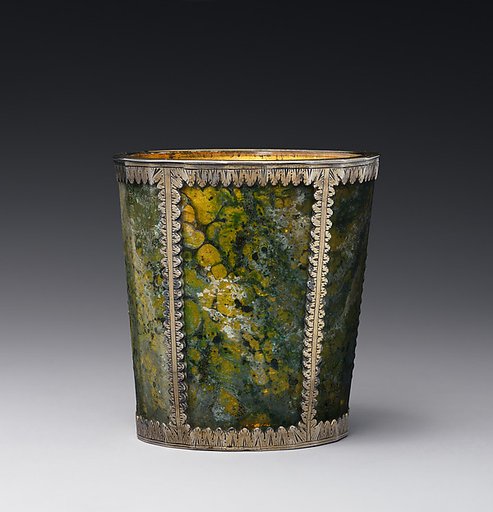
This hardstone vessel is shaped as a small bowl-shaped beaker which tapers slightly towards the base. It is crafted from jasper, a form of chalcedony, an opaque hardstone. The stone appears in a variety of colors, but in this instance is of the type known as "blood jasper," which assumes a deep ruby red color. The surface is highly polished and the vessel in enclosed in handsome gilt-copper mounts featuring a repeating lambrequin-type ornament. The calyx belongs to an exclusive and rare genre of object known today through about 30 surviving examples, most of which are preserved in the Treasury of San Marco in Venice. Because of its deep red color, blood jasper was highly prized by the Byzantines who saw it as a symbol of the blood of Christ. The original function of the vessel cannot be known with certainty. It may have assumed either a secular or liturgical function; however, the use of blood jasper would support the view that the calyx functioned as a liturgical chalice. Chalices in Byzantine Orthodoxy assumed multiple forms. Objects of this quality, materials, and execution are typically associated with circles of the Byzantine court. Such objects were often gifted to churches.
Cleveland Museum of Art’s own description