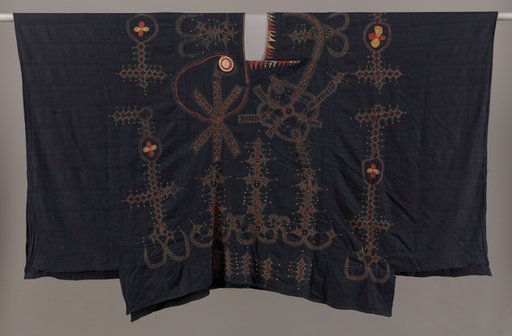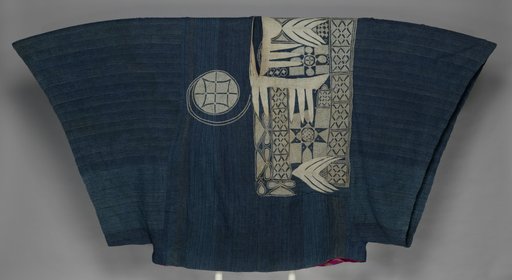
Prestige robe (riga)
From the collection of Cleveland Museum of Art. Free to download, adapt and use — no permission needed.
Elite Nigerian men wore voluminous status garments variously called riga (Hausa), agbádá (Yorùbá), boubou (French), or mbubb (Wolof). Punctuated with white silk, this strip-woven riga’s inky blue was achieved by repeatedly dipping threads into indigo dye before weaving them. Embroiderers were often skilled Arabic calligraphers; the motifs here once had protective Islamic symbolism. The front pocket features the pointed “eight knives” ( aska takwas ) and a leaf ( gambiya ) associated with the Nupe peoples. At back, a spiral leads the wearer toward God. Magenta silk imported via trans-Saharan routes lines the hem. Rigan historically held transcultural appeal; today, they are pan-Nigerian male national dress.
Cleveland Museum of Art’s own description