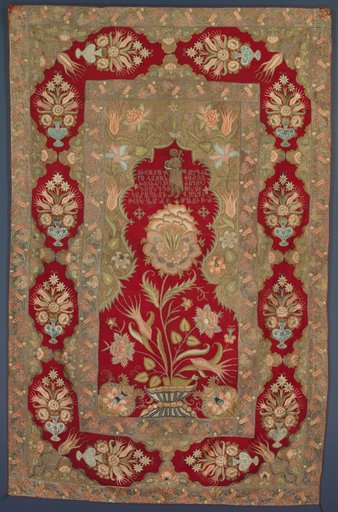
Embroidered Armenian liturgical curtain
From the collection of Cleveland Museum of Art. Free to download, adapt and use — no permission needed.
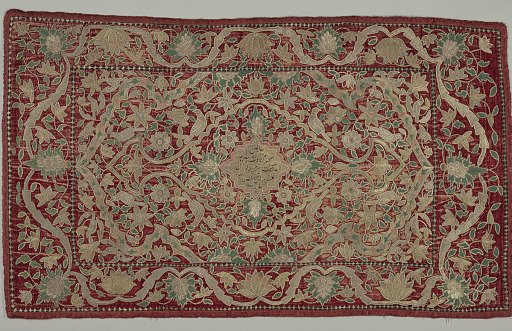
This rare Ottoman embroidery features a floral bouquet that enriches the field under an elegant arch of gilt-metal thread. Flanked by vines of tulips and irises on a silver-metal-thread ground, vases of tulips and jonquils within cartouches adorn the main border and the well-turned corners, a sign of high quality. Dated 1763, the textile documents a mid-18th-century style and technique uncommon in Ottoman embroideries. The Armenian community commissioned this pattern for a liturgical curtain. Beneath the arch, Saint John the Baptist appears with a staff of victory, holding his own severed head in one arm and the Lamb of God in the other. The embroidered Armenian inscription reads: "This curtain is in memory of the people of Hassan Pasha Khan who gave it to the Monastery of Saint John the Baptist on the Armenian date 10 May 1212 [1763]."
Cleveland Museum of Art’s own description