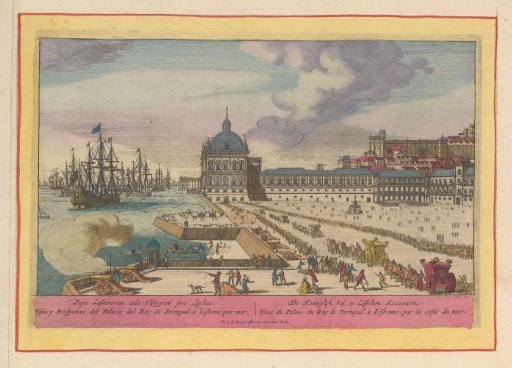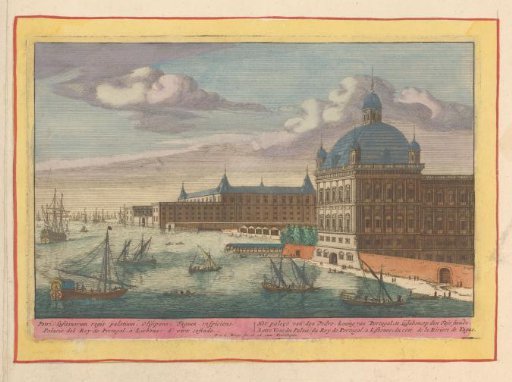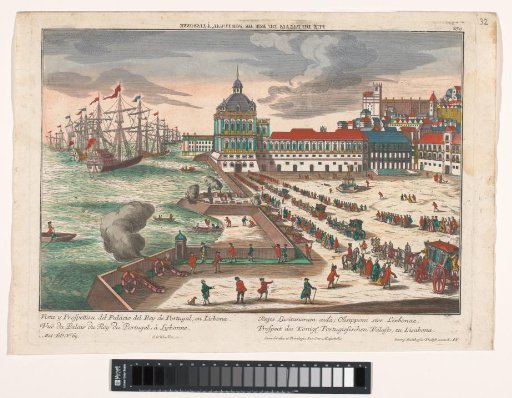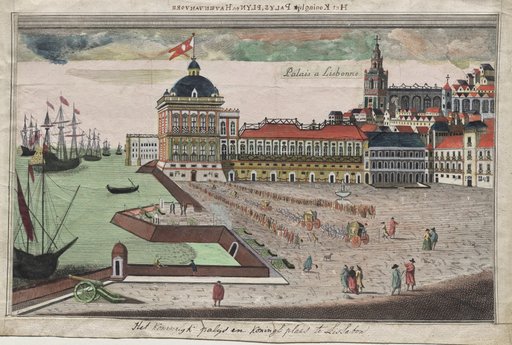
Vista y Prospettiva del Palacio del Rey de Portugal en Lisbona
From the collection of Cleveland Museum of Art. Free to download, adapt and use — no permission needed.
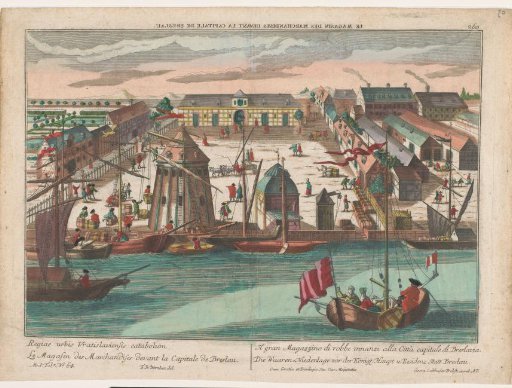
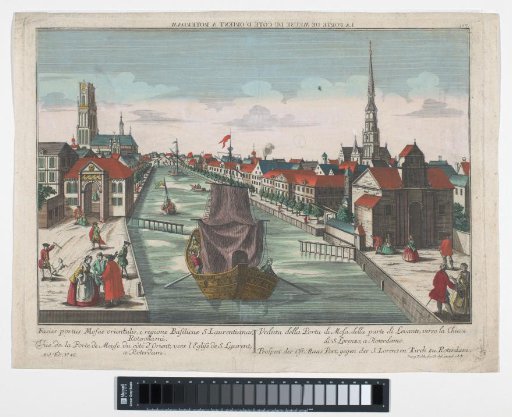
This perspective view (often called a vue d’optique ,or optical view) is an example of a popular art and entertainment format during the second half of the 1700s in Europe. The hand-colored etching and engraving was made to be viewed with a special viewing device consisting of a convex lens and a mirror, so that scene appeared to be a three-dimensional image. Here, the viewer can enjoy a perspective view of the palace of the King of Portugal in Lisbon. Such views—which were only made for a short time and largely disappeared with the advent of photography—appealed to both elite audiences, who viewed collections of images with their own viewing devices in private drawing rooms, and popular audiences, for whom they were street entertainment for a minimal fee.
Cleveland Museum of Art’s own description