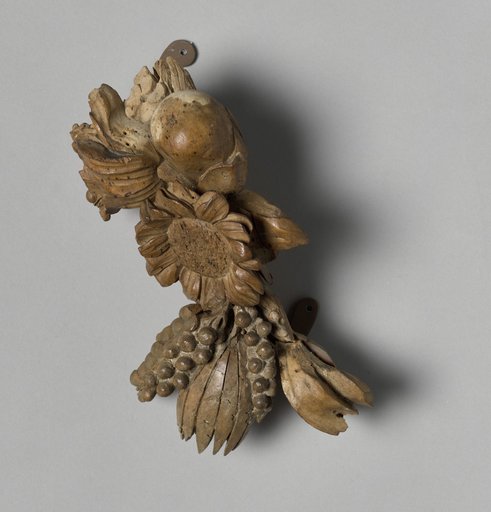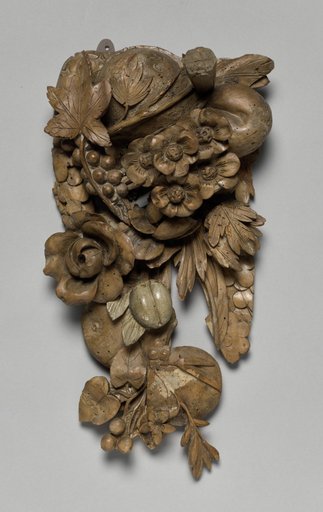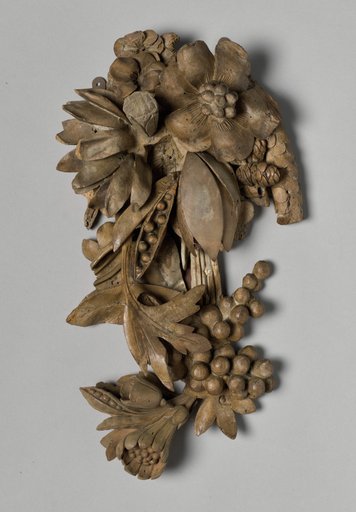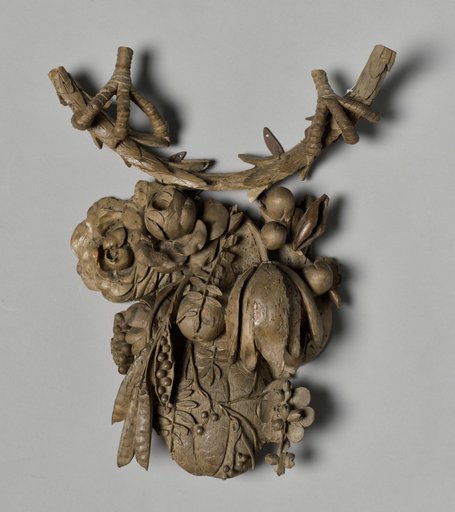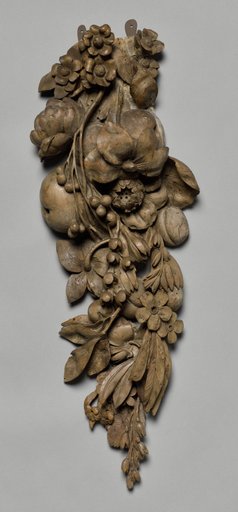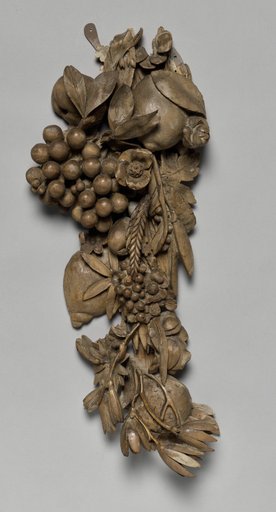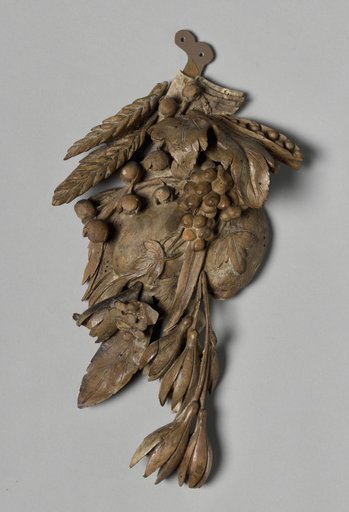
Carving from an Overmantel
From the collection of Cleveland Museum of Art. Free to download, adapt and use — no permission needed.
The arrangement of architectural elements within grand interior spaces in the late 1600s and early 1700s emphasized symmetry and height. Decorative elements such as elaborately carved mantels, mirrors, paintings, and applied wall decorations were often stacked to achieve a visual focal point at one or both ends of the room. This particular overmantel decoration once hung above the fireplace in the Green Drawing Room of the Earl of Essex at Cassiobury in Watford, near London. In 1823, the British painter William Henry Hunt (1790–1864) produced a watercolor of the drawing room which featured this overmantel decoration. Grinling Gibbons was born in Rotterdam, the Netherlands, of English parents. After training there as an artist, he came to England in the 1660s and soon began to work as a sculptor of interior ornament, particularly in wood. One of his first large-scale decorative projects was the series of interiors at Cassiobury House.
Cleveland Museum of Art’s own description