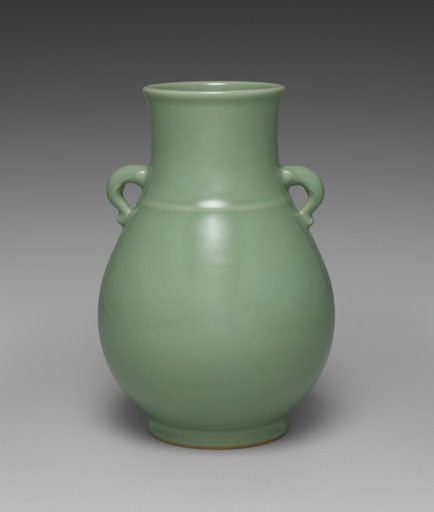
Hu-Shaped Vase with Handles
From the collection of Cleveland Museum of Art. Free to download, adapt and use — no permission needed.
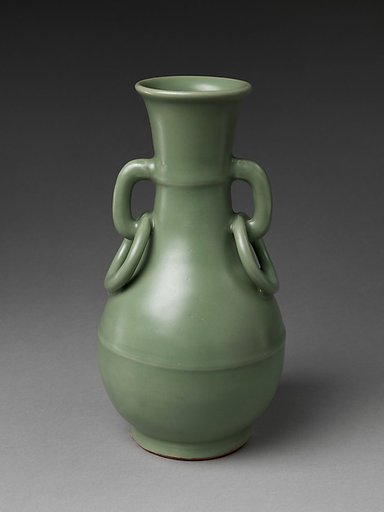
Many of the vases created by Yohei III and IV were made with reference to and in emulation of Chinese ceramics in both form and glazing. The Seifu studio was inspired by later Chinese copies of two other archaic vessel types, the hu (Japanese ko ) and guan (Japanese kan ). In simple terms, in their original contexts, the hu and guan were storage jars that also appeared in ritual contexts. This hu -form vase by Yohei IV has a green glaze and handles in the shape of an elephant head. The details of the elephant heads are quite easy to miss, but a close look reveals that each has carved eyes with pupils defined, tiny ears and tusks in very low relief, and a curved trunk with the end curled up. This sort of container is even known as the “elephant ear” type. The only other decorative element on the vase’s pear-shaped body is a raised cordlike band around the shoulders.
Cleveland Museum of Art’s own description