Water Cooler with Chinese Gardens
From the collection of Cleveland Museum of Art. Free to download, adapt and use — no permission needed.
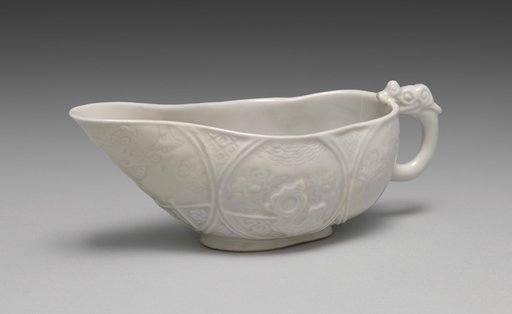
Unlike most pieces by the Seifu Yohei studio, this one bears a seal beneath the handle rather than on the base. The glaze and technique are identified on the box as taihakuji , or “great white porcelain,” an important early invention Yohei III devised in 1872 that involved the combination of a distinctive translucent, creamy glaze over an ivory-colored clay body. The body’s two sides have garden scenes seen through windows. Designs of flowers and butterflies are incised in the spaces at both ends. The garden on the right-hand side of the vessel, seen through a round window, has a decorative rock with grasses beneath a cloudy sky; and on a tiled veranda, there is a teapot as well as a fan and two scrolls inserted into a double-handled urn or kettle atop a brazier. The garden on the left-hand side has two enormous flowers below what may be either a cloud or a rippling pond; a garden rock—or perhaps a carved wood sculpture—with a circular perforation sits on what appears to be a veranda. While the details may be open to interpretation, the setting is a rather glamorous Chinese residence or palace with a superbly tended garden in spring or summer.
Cleveland Museum of Art’s own description