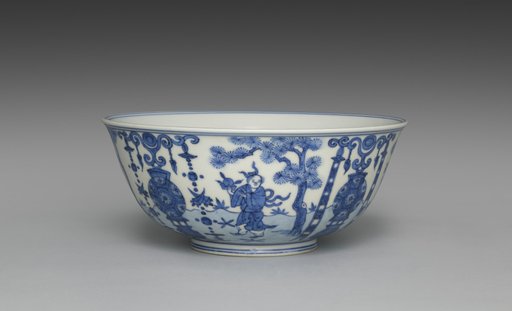
Bowl from Nesting Bowls with Daoist Immortals
From the collection of Cleveland Museum of Art. Free to download, adapt and use — no permission needed.
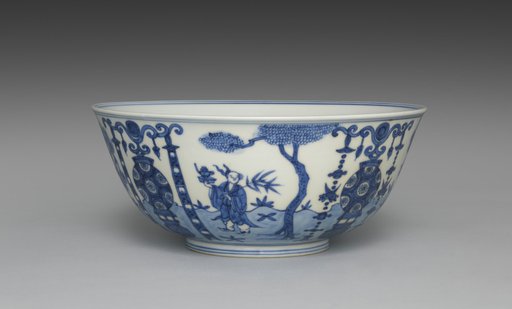
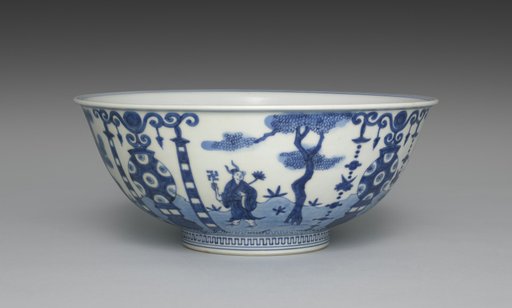
Yohei III was capable of ink painting–like compositions in underglaze blue, as well as more decorative ones like that on this set of three nesting bowls. Bowls with very similar designs in five colors were produced in the reign of the Wanli emperor (reigned 1572–1620) during the Ming dynasty, and Yohei must have had direct access to one of these or to a close copy. A scene of Daoist immortals is presented on the bowls. On each one, the ground plane is defined with a blue wash. Four lanterns are evenly spaced around the bowl. Two are flanked with linked-piece metalwork banners of the seven treasures. The alternate altars are adorned with textile banners. In between them are four immortals, each standing beneath a tree with small plants surrounding his feet. Two of the immortals hold fruit on a tray. Another carries an elixir-filled ewer and a willow branch. The fourth holds a swastika ( manji ), here an auspicious symbol, and a flower. Curiously, the inscription inside each footring reads “Made by Seifu of Great Japan,” in emulation of the dynasty and reign inscriptions that appear on Chinese ceramics; however, one can also see through the translucent glaze another inscription, “Seifu Yohei,” written in large characters within a double band of blue on the largest bowl.
Cleveland Museum of Art’s own description